
Our Verdict
Choose the FP-30X if built-in Bluetooth MIDI and a wider sound selection matter most. Choose the P-225 if you want a lighter instrument, Yamaha’s CFX piano sound and a two-track recorder for practising hands separately. Action and tone remain personal choices, so try both with the same headphones if you can.
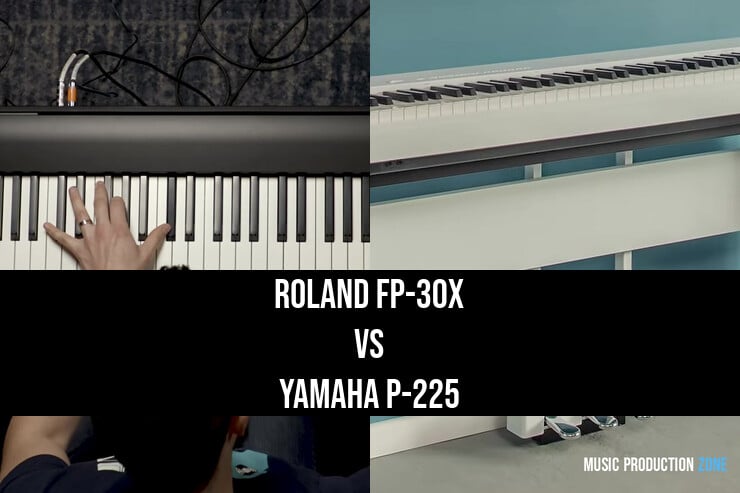
Roland FP-30X vs Yamaha P-225 (2026) Head to Head
Yamaha P-225
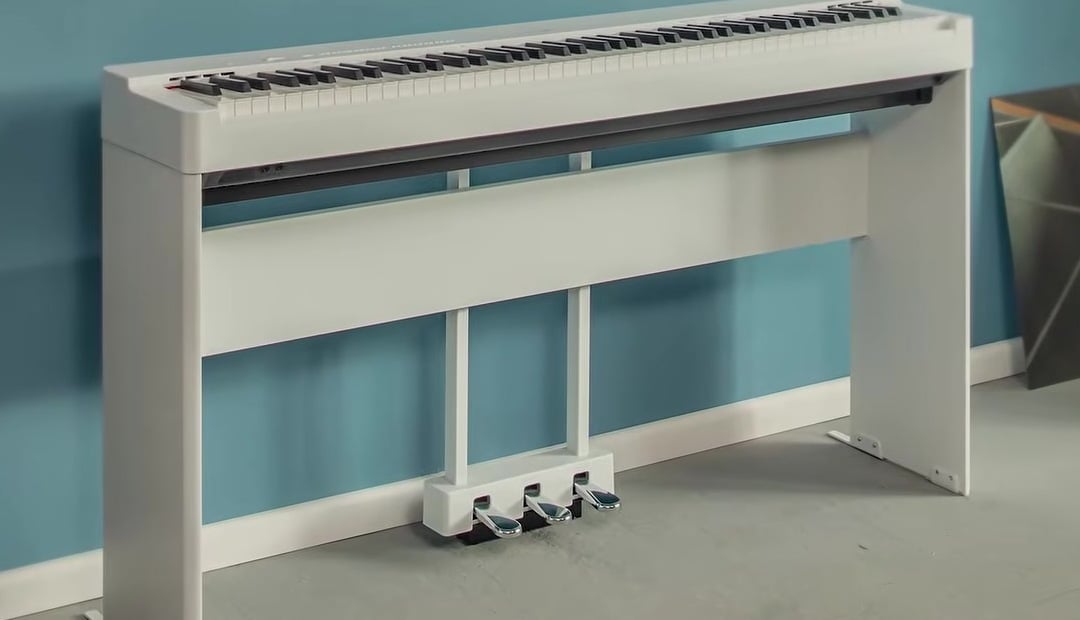
Shown in white with the optional stand and pedal unit. The linked product is the black instrument alone.
View PriceThe Roland FP-30X and Yamaha P-225 are portable digital pianos for lessons, home practice and occasional performances. Both give you 88 weighted keys, built-in speakers and direct USB recording. The Roland offers broader wireless connectivity and more sounds, while the Yamaha is easier to carry and centres its acoustic piano sound on Yamaha’s CFX concert grand.
Key Differences
| Feature | Roland FP-30X | Yamaha P-225 |
|---|---|---|
| Keyboard action | PHA-4 Standard; escapement and Ivory Feel | GHC (Graded Hammer Compact); matte black keytops |
| Sound engine | SuperNATURAL Piano | Yamaha CFX samples; VRM Lite resonance |
| Maximum polyphony | 256 notes | 192 notes |
| Sounds | 56 from panel; 321 through Roland Piano App | 24 |
| Bluetooth audio | Yes; audio input | Yes; input only, regional availability |
| Bluetooth MIDI | Yes | No built-in; optional UD-BT01 for compatible iOS connections |
| Recording | One-part, one-song SMF recorder; save to USB; audio file playback | One-song, two-track MIDI recorder; approximately 11000 notes |
| Speaker amplification per side | 11 W | 7 W |
| Weight | 14.8 kg including music rest | 11.5 kg |
| Dimensions | 1300 x 284 x 151 mm (W x D x H), music rest detached | 1326 x 272 x 129 mm (W x D x H), music rest detached |
Keyboard and piano sound: Roland uses its PHA-4 Standard action with escapement and Ivory Feel key surfaces, paired with SuperNATURAL Piano. Yamaha uses its compact GHC action, CFX samples and VRM Lite resonance modelling. Those are different designs; the specifications alone cannot tell you which will suit your hands or musical taste.
Carrying weight: Yamaha lists the P-225 at 11.5 kg. Roland lists the FP-30X at 14.8 kg including its music rest. The published figures put the Yamaha around 3.3 kg lighter, although their music-rest conventions differ. The P-225 is also slightly shallower and lower, while the Roland is slightly narrower.
Wireless connections: The FP-30X has Bluetooth audio and MIDI built in. The P-225 has Bluetooth audio where available, but wireless MIDI requires an optional compatible adapter; Yamaha lists the UD-BT01 for iOS. Bluetooth audio brings backing tracks into the piano. It does not mean either instrument sends its playing to Bluetooth headphones.
Sounds and speakers: The FP-30X exposes 56 tones from its panel, with 321 accessible through the Roland Piano App. The P-225 has 24 voices. Roland’s amplification is 11 W per side; Yamaha’s is 7 W per side with separate tweeters. More voices help if you want variety, but sound count and amplifier wattage do not establish better piano tone.
Recording: Yamaha’s internal MIDI recorder has two tracks, useful for recording one hand and practising the other over it. Roland’s internal recorder is one part, and its USB memory port lets you save recordings and play supported audio files. Both can record their own sounds into compatible computer software through USB audio.
Key Features in Common
| Feature | Roland FP-30X | Yamaha P-225 |
|---|---|---|
| Instrument type | Portable digital piano | Portable digital piano |
| Number of keys | 88 | 88 |
| Weighted hammer-action keys | Yes | Yes |
| Audio recording over USB | Yes | Yes |
| MIDI over USB | Yes | Yes |
| Headphone sockets | 2 | 2 |
| Line output channels | 2 | 2 |
| Power options | AC adaptor | AC adaptor |
| 5-pin MIDI ports | None | None |
| Physical organ drawbars | None | None |
Both offer an 88-key hammer-action keyboard, layer and split modes, a metronome and a mode that divides the keyboard into matching pitch ranges for lessons. Each has two headphone sockets and separate left/right line outputs for connecting to powered speakers or a PA.
Both support USB MIDI as well as USB audio, so they can control a software piano or record their onboard sound. Their maximum published polyphony is ample for many piano arrangements: 256 notes for Roland and 192 for Yamaha. Layering and sustained notes use that capacity, so this is a headroom figure rather than a sound-quality score.
Practical Buying Considerations
Pedals and furniture: Both standard packages include a basic footswitch and music rest. A piano-style pedal with half-pedalling support is a sensible extra for expressive sustain control. Roland lists the DP-10 and the KSC-70/KPD-70 furniture combination; Yamaha lists the FC3A and L-200/LP-1 combination. Neither standard instrument package includes a bench or furniture stand.
Recording workflow: Use a wired USB connection for a DAW session, check the manufacturer’s current driver guidance for your operating system, and monitor through wired headphones or the piano speakers. If you record Yamaha’s USB audio in software, its reference manual advises turning Audio Loopback off to prevent an audio feedback loop.
Full Specifications
Keyboard and sound
| Feature | Roland FP-30X | Yamaha P-225 |
|---|---|---|
| Instrument type | Portable digital piano | Portable digital piano |
| Number of keys | 88 | 88 |
| Keyboard action | PHA-4 Standard; escapement and Ivory Feel | GHC (Graded Hammer Compact); matte black keytops |
| Sound engine | SuperNATURAL Piano | Yamaha CFX samples; VRM Lite resonance |
| Maximum polyphony | 256 notes | 192 notes |
| Sounds | 56 from panel; 321 through Roland Piano App | 24 |
Speakers and pedals
| Feature | Roland FP-30X | Yamaha P-225 |
|---|---|---|
| Built-in speakers | 2 x 11 W; two 12 cm speakers | 2 x 7 W; two 12 x 8 cm oval speakers plus two 5 cm tweeters |
| Pedal support | DP-2 switch included; optional DP-10 continuous damper or KPD-70 triple pedals | Footswitch included; optional FC3A half-pedal and LP-1 triple pedal unit |
| Included equipment | DP-2 pedal switch, music rest, AC adaptor and power cord | Music rest, footswitch; AC adaptor inclusion varies by region |
| Optional equipment | Optional KSC-70 stand, KPD-70 pedal unit, DP-10 pedal, bench/case | Optional L-200 stand, LP-1 pedal unit, FC3A sustain pedal, bench/case |
Recording and connectivity
| Feature | Roland FP-30X | Yamaha P-225 |
|---|---|---|
| USB audio | Yes; USB Computer audio/MIDI | Yes; 44.1 kHz/24-bit stereo |
| USB MIDI | Yes | Yes |
| Bluetooth audio | Yes; audio input | Yes; input only, regional availability |
| Bluetooth MIDI | Yes | No built-in; optional UD-BT01 for compatible iOS connections |
| Outputs | L/Mono and R 6.35 mm line outs; 6.35 mm and 3.5 mm headphone jacks | L/L+R and R 6.35 mm AUX outs; two 6.35 mm headphone jacks |
| Recording | One-part, one-song SMF recorder; save to USB; audio file playback | One-song, two-track MIDI recorder; approximately 11000 notes |
| Splits, layers and performance | Layer, split and Twin Piano | Layer, split and Duo |
Comparison essentials
| Feature | Roland FP-30X | Yamaha P-225 |
|---|---|---|
| Weighted hammer-action keys | Yes | Yes |
| Audio recording over USB | Yes | Yes |
| MIDI over USB | Yes | Yes |
| Headphone sockets | 2 | 2 |
| Line output channels | 2 | 2 |
| Speaker amplification per side | 11 W | 7 W |
| Power options | AC adaptor | AC adaptor |
| 5-pin MIDI ports | None | None |
| Physical organ drawbars | None | None |
Portability
| Feature | Roland FP-30X | Yamaha P-225 |
|---|---|---|
| Weight | 14.8 kg including music rest | 11.5 kg |
| Dimensions | 1300 x 284 x 151 mm (W x D x H), music rest detached | 1326 x 272 x 129 mm (W x D x H), music rest detached |
Verdict
The FP-30X is the more flexible choice on paper for wireless app use and a wider range of sounds. The P-225 makes a strong case if you move the piano often, prefer Yamaha’s CFX sound or want to practise with a two-track internal recording. Both cover the essentials for learning and home recording; keyboard feel and your preferred piano tone should decide a close choice.
Yamaha P-225
Shown in white with the optional stand and pedal unit. The linked product is the black instrument alone.
View Price