
Our Verdict
Choose the FP-10 for a straightforward practice instrument, especially if you usually play with headphones. Choose the FP-30X for direct USB audio recording, dedicated line outputs, stronger onboard amplification or a three-pedal furniture setup. A beginner can learn on either; the extra facilities matter when you will use them.
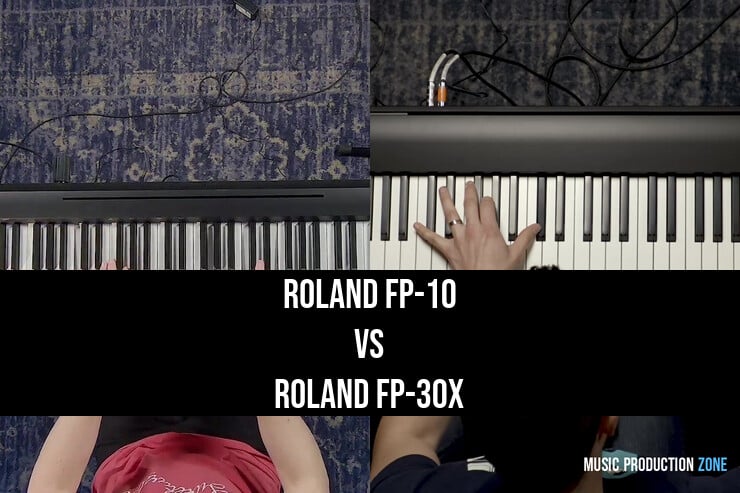
Roland FP-10 vs Roland FP-30X (2026) Head to Head
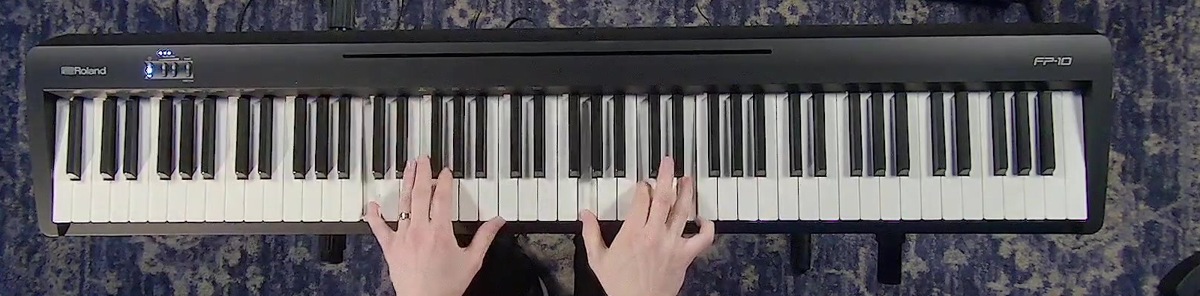
The Roland FP-10 and FP-30X are portable digital pianos with 88 weighted keys. Both use the PHA-4 Standard action and SuperNATURAL Piano sound, so the FP-30X upgrade is chiefly about speakers, sounds, recording and connections. The FP-10 focuses on home practice; the FP-30X is easier to integrate into a recording or performance setup.
Key Differences
| Feature | Roland FP-10 | Roland FP-30X |
|---|---|---|
| Maximum polyphony | 96 notes | 256 notes |
| Sounds | 15 from panel; 36 through Roland Piano App | 56 from panel; 321 through Roland Piano App |
| Bluetooth audio | No | Yes; audio input |
| Recording | No onboard recorder listed; record MIDI in connected software | One-part, one-song SMF recorder; save to USB; audio file playback |
| Audio recording over USB | No | Yes |
| Headphone sockets | 1 | 2 |
| Line output channels | 0 | 2 |
| Speaker amplification per side | 6 W | 11 W |
| Weight | 12.6 kg without music rest | 14.8 kg including music rest |
| Dimensions | 1284 x 258 x 140 mm (W x D x H), music rest detached | 1300 x 284 x 151 mm (W x D x H), music rest detached |
Computer recording: The FP-10 sends MIDI over USB but does not provide USB audio. You can use it to play a software piano, but capturing its own sound requires an analog recording connection. The FP-30X sends both MIDI and audio over USB, making it simpler to record its onboard tone in compatible software. MIDI stores performance instructions; audio stores the sound you hear.
Speakers and polyphony: The FP-10 has 6 W per side and 96-note maximum polyphony. The FP-30X has 11 W per side and 256-note maximum polyphony. Extra polyphony provides more headroom for layers and sustained passages; neither the note count nor wattage is a complete measure of tone quality. Compare the sound at a comfortable listening level if possible.
Performance connections: The FP-30X adds separate left/right line outputs and two headphone sockets. The FP-10 has one stereo headphones/output jack. The dedicated outputs are convenient for a PA or powered speakers without relying on the headphone connection.
Practice and sounds: The FP-30X offers a wider tone selection, split mode, an internal recorder and USB-memory playback. It also supports Bluetooth audio for backing tracks; the FP-10's Bluetooth connection is for MIDI. Bluetooth audio input does not provide wireless headphone output.
Key Features in Common
| Feature | Roland FP-10 | Roland FP-30X |
|---|---|---|
| Instrument type | Portable digital piano | Portable digital piano |
| Number of keys | 88 | 88 |
| Keyboard action | PHA-4 Standard; escapement and Ivory Feel | PHA-4 Standard; escapement and Ivory Feel |
| Sound engine | SuperNATURAL Piano | SuperNATURAL Piano |
| Bluetooth MIDI | Yes | Yes |
| Weighted hammer-action keys | Yes | Yes |
| MIDI over USB | Yes | Yes |
| Power options | AC adaptor | AC adaptor |
| 5-pin MIDI ports | None | None |
| Physical organ drawbars | None | None |
Both provide a full 88-key PHA-4 Standard keyboard with escapement and Ivory Feel surfaces, plus layer and Twin Piano modes. Each has built-in speakers, a metronome, USB MIDI and Bluetooth MIDI where supplied in the region. An optional DP-10 pedal supports half-pedalling on either.
Sharing an action family makes the FP-10 a credible choice for learning touch and dynamics. It does not guarantee that the complete instruments will sound identical through their speakers or headphones.
Practical Buying Considerations
Pedals and stands: The FP-10 supports a sustain pedal; the FP-30X can also use Roland's compatible three-pedal furniture combination. Choose the setup around the playing techniques and floor space you need. A bench and suitable stand are part of making either instrument comfortable for daily practice.
Moving the instrument: Roland lists the FP-10 at 12.6 kg without its music rest and the FP-30X at 14.8 kg with its rest. Those figures use different conventions, but the FP-10 is the smaller option. Check the instrument, stand and carrying case together if you move frequently.
App use: Check regional Bluetooth availability and current app compatibility. Use a wired connection for recording when timing matters, and distinguish controlling a software piano from recording the instrument's internal sounds.
Full Specifications
Keyboard and sound
| Feature | Roland FP-10 | Roland FP-30X |
|---|---|---|
| Instrument type | Portable digital piano | Portable digital piano |
| Number of keys | 88 | 88 |
| Keyboard action | PHA-4 Standard; escapement and Ivory Feel | PHA-4 Standard; escapement and Ivory Feel |
| Sound engine | SuperNATURAL Piano | SuperNATURAL Piano |
| Maximum polyphony | 96 notes | 256 notes |
| Sounds | 15 from panel; 36 through Roland Piano App | 56 from panel; 321 through Roland Piano App |
Speakers and pedals
| Feature | Roland FP-10 | Roland FP-30X |
|---|---|---|
| Built-in speakers | 2 x 6 W; two 12 cm speakers | 2 x 11 W; two 12 cm speakers |
| Pedal support | Included switch pedal; optional DP-10 supports half-pedal | DP-2 switch included; optional DP-10 continuous damper or KPD-70 triple pedals |
| Included equipment | Music rest, pedal switch, AC adaptor and power cord | DP-2 pedal switch, music rest, AC adaptor and power cord |
| Optional equipment | Stand, bench, headphones/case optional | Optional KSC-70 stand, KPD-70 pedal unit, DP-10 pedal, bench/case |
Recording and connectivity
| Feature | Roland FP-10 | Roland FP-30X |
|---|---|---|
| USB audio | No | Yes; USB Computer audio/MIDI |
| USB MIDI | Yes | Yes |
| Bluetooth audio | No | Yes; audio input |
| Bluetooth MIDI | Yes | Yes |
| Outputs | One 3.5 mm stereo headphones/output jack; no dedicated line outs | L/Mono and R 6.35 mm line outs; 6.35 mm and 3.5 mm headphone jacks |
| Recording | No onboard recorder listed; record MIDI in connected software | One-part, one-song SMF recorder; save to USB; audio file playback |
| Splits, layers and performance | Layer and Twin Piano; no independent split mode | Layer, split and Twin Piano |
Comparison essentials
| Feature | Roland FP-10 | Roland FP-30X |
|---|---|---|
| Weighted hammer-action keys | Yes | Yes |
| Audio recording over USB | No | Yes |
| MIDI over USB | Yes | Yes |
| Headphone sockets | 1 | 2 |
| Line output channels | 0 | 2 |
| Speaker amplification per side | 6 W | 11 W |
| Power options | AC adaptor | AC adaptor |
| 5-pin MIDI ports | None | None |
| Physical organ drawbars | None | None |
Portability
| Feature | Roland FP-10 | Roland FP-30X |
|---|---|---|
| Weight | 12.6 kg without music rest | 14.8 kg including music rest |
| Dimensions | 1284 x 258 x 140 mm (W x D x H), music rest detached | 1300 x 284 x 151 mm (W x D x H), music rest detached |
Verdict
The FP-10 covers the essentials of weighted-key practice without a complicated setup. The FP-30X adds practical room to grow through recording, stronger amplification and more flexible connections. Choose the upgrade for the features you expect to use, while giving keyboard comfort and piano tone a personal audition.