
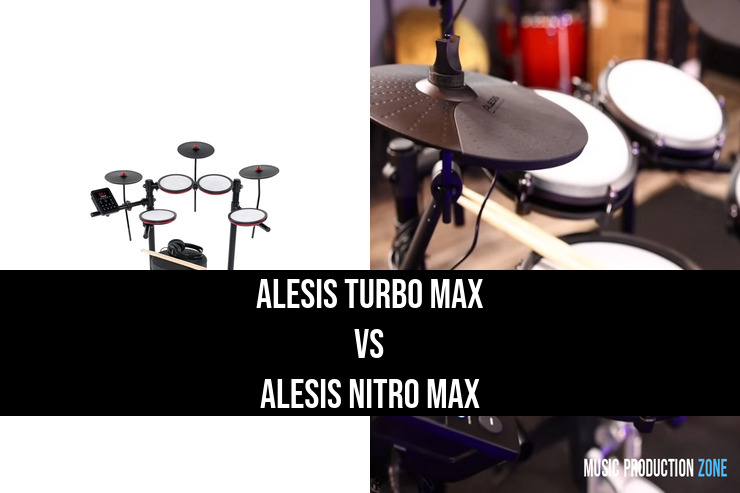
The Nitro Max is the better choice for regular drum practice if you can add a throne and headphones. Its beater pedal, continuous hi-hat controller, snare rim zone and expansion inputs give you more room to develop. Choose the Turbo Max for a simple first setup when included accessories and a kick pedal without a beater are priorities. Do not buy it expecting to replace that switch pedal with a kick tower later.
Alesis Turbo Max vs Alesis Nitro Max (2026) Head to Head


The Alesis Turbo Max is a beginner package with mesh drum pads, a stool, headphones and two switch pedals. The Nitro Max takes a more conventional approach, using a kick tower and beater pedal, a larger dual-zone snare and a module with editable user kits.
Both can help a new drummer learn grooves and play along with music over Bluetooth. The buying question is whether a complete, simple starter package is enough, or whether you want hardware that gives you more control as your technique develops. Turbo Max is a separate model from the older Turbo Mesh kit.
Key Differences
The kick system is the main reason to choose Nitro Max. Its pedal swings a beater into a kick tower, allowing the pad to respond to how hard you play. Turbo Max uses a momentary switch pedal without velocity data. It can teach where the kick falls in a groove, but it cannot reproduce the same range of kick dynamics or beater rebound.
The Turbo Max hi-hat pedal is also a switch. Nitro Max has a continuous controller supporting open, half-open and closed sounds, with foot chick and splash. Both cymbal pads remain fixed on the rack. Nitro Max gives your left foot more control over the sound, while neither has a moving hi-hat on an acoustic stand.
Turbo Max has an 8-inch single-zone mesh snare. Nitro Max increases that to a 10-inch dual-zone mesh snare, giving you more target area and a separate rim trigger. Both have three 8-inch single-zone mesh toms. Upgrading to Nitro Max therefore changes the snare more than the tom layout.
The cymbal pads grow from 8 inches on Turbo Max to 10 inches on Nitro Max. Nitro Max also has a chokeable crash. Its ride remains single-zone, so this upgrade does not give you a separate ride bell or multi-zone toms.
Turbo Max provides 12 preset kits without a bank for saving custom kits. Nitro Max provides 32 factory kits and 16 user slots, where you can save sound assignments and pad settings. That is useful when you want one practice setup to stay consistent instead of choosing a different preset each time.
Nitro Max has separate Tom 4 and Crash 2 inputs for compatible expansion pads. Turbo Max has no additional pad sockets. Alesis also rules out replacing its switch pedals with a kick pad or a stand-mounted hi-hat setup. If those are likely future purchases, starting with Nitro Max avoids building a plan around incompatible upgrades.
The Alesis Turbo Max is equipped with the Turbo Max, while the Alesis Nitro Max uses the Nitro Max Drum Module.
Key Features in Common
Both kits have mesh snare and tom pads with adjustable head tension, three cymbal positions and a rack. Both produce their own sounds without a computer and include sticks, cabling and a power supply.
Both modules have Bluetooth audio and a wired auxiliary input for backing tracks. Bluetooth brings music into the module; it is not a low-latency wireless connection for drum headphones. Use the headphone socket when practising.
Both provide a metronome, play-along songs and an internal performance recorder. Both send USB MIDI to a computer, so either can trigger a software drum instrument. Neither streams its onboard drum sounds as USB audio or imports user samples into the module.
And here's a video of the Alesis Nitro Max.
The Turbo Max package includes a throne and headphones. Standard Nitro Max includes a kick pedal and hi-hat pedal, but you need to provide the seat and listening system. Compare the contents of the actual offers, since a retailer accessory bundle can add items that are absent from the standard kit.
Check the seated height and pedal reach before committing to either rack. Smaller pads can help fit the Turbo Max into a practice corner, but a compact layout is only useful if your knees, elbows and sticks have enough room. Leave space behind the kit for the throne and a clear route around its legs.
The Turbo Max kick has no beater striking a tower. That removes one impact source, which may be useful in shared accommodation, but the pedals and rack can still transmit vibration. Nitro Max's kick tower adds a physical strike to the floor-mounted setup. Use headphones, a stable rug and sensible practice hours with either; neither is silent.
For computer recording, USB MIDI captures timing and note information for a software instrument. It does not add a snare rim sensor or kick velocity to the Turbo Max hardware. Software can change the available sounds, but it cannot recover playing information that a switch pedal never sent.
To record the module's own sound, connect its analogue output to an audio interface. Each module has a single stereo 1/4-inch main output; use an appropriate breakout cable when recording stereo into two inputs. Keep this separate from the internal practice recorder, which is intended for listening back to a performance at the kit.
Price Comparison Between The Alesis Turbo Max and Alesis Nitro Max
Use the below to get up-to-date prices for both the Alesis Turbo Max and Alesis Nitro Max
Hi-Hat
Cymbal Pads
Toms
Drum Module
Snare
Kick
Overview
Verdict
Choose Nitro Max if learning beater control, hi-hat variation and snare head/rim playing is part of your plan. It is the more useful starting point for a drummer who expects to practise regularly and add pads later. Turbo Max suits a simpler introduction when its supplied seat and headphones help complete the setup and you accept the switch-pedal limitations.
For the next hardware step within Alesis, read Nitro Max vs Nitro Pro. If a moving hi-hat and more cymbal zones matter more than Bluetooth, see Nitro Max vs Millenium MPS-850.

Matt Taylor