
Choose the MPS-1500 Hybrid-X if you will use the Nexus pads for additional percussion, imported samples or a small standalone setup away from the full kit. Choose the MPS-1000 if you mainly want a five-piece mesh kit with acoustic-style positioning and hands-on volume faders. An existing MPS-1000 owner should have a use for the multipad before replacing the complete set: both kits already provide eight direct outputs and similar drum and cymbal sizes.
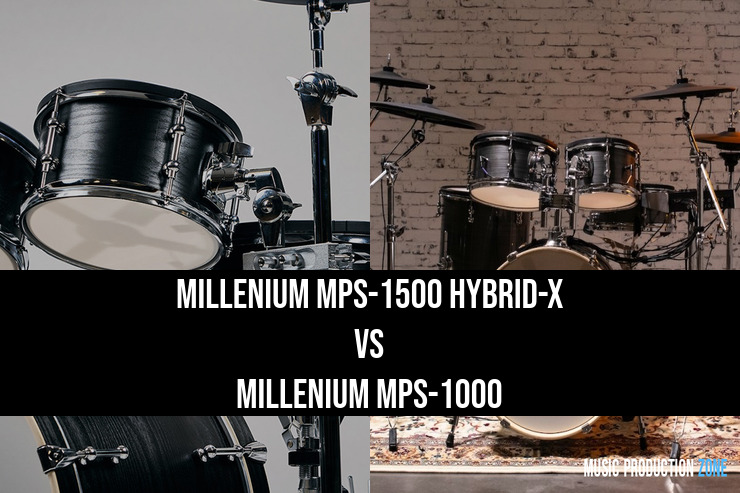
Millenium MPS-1500 Hybrid-X vs Millenium MPS-1000 (2026) Head to Head

The Millenium MPS-1500 Hybrid-X is worth the step up if you want the Nexus module's nine playing pads for samples and percussion alongside a full drum kit. The MPS-1000 remains a sensible choice for a conventional acoustic-style layout with mesh heads and separate audio outputs. You do not need the newer kit just to get wood shells, a moving hi-hat or an 18-inch ride.
This comparison uses the standard MPS-1000 with two rack toms and one floor tom. Its D2 configurations change the tom layout, so they are a separate buying decision. The biggest difference here is the module and how you intend to use it.
Key Differences
The Nexus is both the MPS-1500's sound module and a percussion pad with nine assignable playing surfaces. You can put extra sounds within reach without mounting nine more external pads, or use the Nexus by itself for a smaller performance setup. The MPS-1000 module has no onboard playing pads; its controls are arranged around operating the connected drum kit.
The MPS-1000 has nine illuminated volume faders and a 3.2-inch colour display. Nexus uses a larger 4.3-inch colour display and rotary controls. Faders are convenient for adjusting the kit balance while playing; the Nexus surfaces are more useful if triggering additional parts is central to your music. Neither module has the Strata range's touchscreen workflow.
The MPS-1500 has a 22-inch bass drum, compared with the MPS-1000's 20-inch bass drum. Both are wood-shell mesh drums rather than small kick towers. The larger shell changes the stage appearance and the space needed around the setup; it does not establish better triggering by itself.
Nexus provides 80 factory kits and 80 user-kit slots, while the MPS-1000 provides 40 of each. Nexus also has a larger onboard voice library. Those counts describe the available choices, not a measured sound-quality advantage. Listen for the acoustic kits or electronic sounds you actually need before deciding that a larger library is worth replacing the module.
User-sample capacity increases from up to 100 files and 335 MB on MPS-1000 to 600 files and 500 MB on Nexus. The newer system gives more room for separate one-shots and loops. Prepare files in the supported format and keep a backup outside the module; sample import is different from recording new audio directly into the instrument.
The Millenium MPS-1500 Hybrid-X is equipped with the Nexus, while the Millenium MPS-1000 uses the MPS-1000.
Key Features in Common
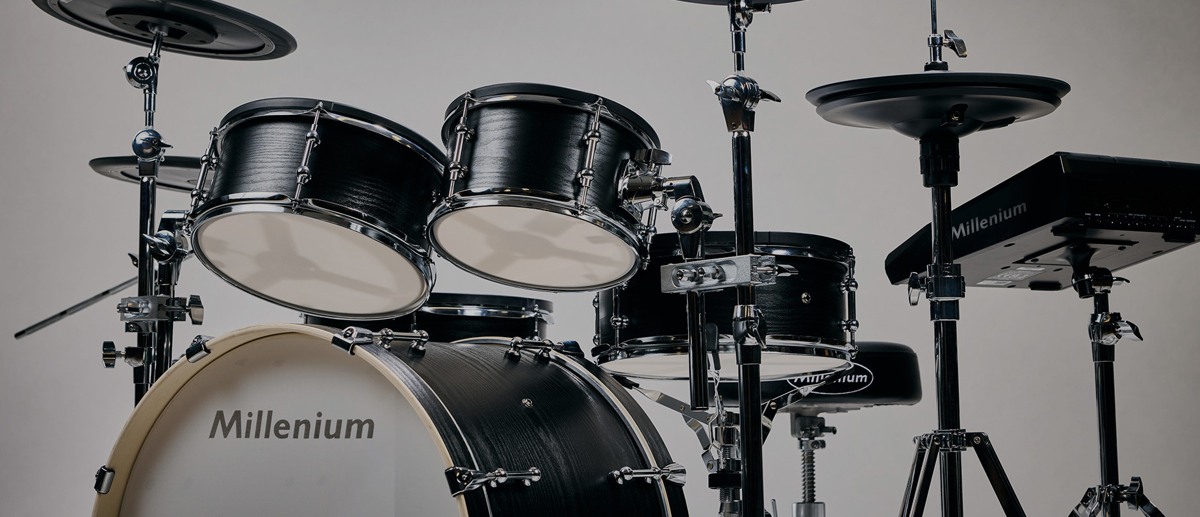
Both standard kits have a 13-inch dual-zone mesh snare, 10-inch and 12-inch rack toms, and a 14-inch floor tom. Head and rim zones let you assign different sounds without adding another drum. The adjustable mesh heads allow tension changes, although tension alone cannot make electronic pads behave exactly like acoustic drums.
Both provide a 13-inch hi-hat on a conventional stand, two 15-inch crashes and an 18-inch three-zone ride. The crashes support choking, and the ride has a separate bell zone. The newer kit does not add another crash or tom to this standard layout.
Both modules have main left/right outputs, eight assignable direct outputs, USB MIDI, Bluetooth music input and a wired auxiliary input. Both can play their own sounds without a computer. These shared connections matter more than the difference in preset counts if you are connecting the kit to a mixer or software drum instrument.
And here's a video of the Millenium MPS-1000.
For recording the module's own sounds, connect the main outputs to an audio interface for a stereo mix, or use the direct outputs with enough interface inputs for separate feeds. The MPS-1000 already offers that second route. Buying the MPS-1500 does not remove the need for audio-interface inputs and cabling. USB MIDI carries the performance to drum software; it does not carry those analogue output channels into the computer as audio.
Place Nexus where you can strike its pads comfortably without reaching over a cymbal. Its nine surfaces are part of the module, so they do not have the same positioning freedom as individual pads on stands. If you only need one extra sound, an assignable rim or a compatible expansion pad may be a simpler change to your existing kit.
Both standard sets include cymbal stands, a hi-hat stand, snare support and a single kick pedal. You still need a throne and headphones or amplification. Their full shells and separate stands require room for the drums, stand legs, seat and pedal movement; neither is a compact rack kit for packing into a small corner.
Update the module with the correct manufacturer package before building a collection of user kits, and save a backup before later updates. Recheck hi-hat calibration and trigger settings after assembly. Floor vibration from the kick pedal and stick noise remain relevant in shared accommodation, even when you play through headphones.
For expansion, check the proposed pad and cable against the particular module. Nexus has five additional external trigger inputs alongside the kit connection, but that is not a guarantee that any pad will retain all of its zones. Keep hi-hat controller compatibility separate from ordinary drum-pad compatibility.
Price Comparison Between The Millenium MPS-1500 Hybrid-X and Millenium MPS-1000
Use the below to get up-to-date prices for both the Millenium MPS-1500 Hybrid-X and Millenium MPS-1000
Hi-Hat
Cymbal Pads
Toms
Drum Module
Snare
Kick
Overview
Verdict
The MPS-1500 Hybrid-X makes the most sense for a drummer who wants to combine a full wood-shell kit with the Nexus multipad. The MPS-1000 covers much of the same basic kit layout and analogue recording connectivity. If you will not use the extra playing surfaces or sample capacity, its familiar fader-based module is a good reason to keep the decision simple.
If the full-shell format is the part you are unsure about, compare MPS-1500 Hybrid-X vs Alesis Strata Club for the alternative of a smaller rack kit and touchscreen module.

Matt Taylor