
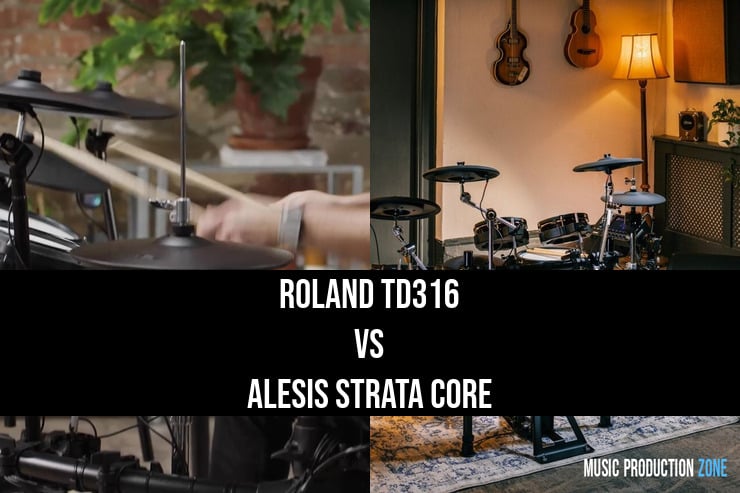
The TD316 is the stronger choice if you want to record the module's sounds into a DAW through one USB cable. The Strata Core is more appealing if you prefer touchscreen editing, triple-zone crashes and a larger mesh kick surface. Their similar prices make your recording workflow and cymbal preferences more useful deciding factors than the size of either sound library.
Roland TD316 vs Alesis Strata Core (2026) Head to Head


The Roland TD316 and Alesis Strata Core are midrange electronic drum sets with similar pad sizes and almost identical US prices. Both provide mesh drums, two crashes and a stand-mounted hi-hat. The TD316 puts more emphasis on direct computer recording and Roland's expansion system, while the Strata Core offers a touchscreen module and triple-zone ARC cymbals.
Key Differences
The TD316 uses the V31 module with a 4.3-inch colour display. The Strata Core has a 7-inch touchscreen and an onboard BFD sound engine. Both work without a computer, but their editing interfaces are quite different.
The Core's two 12-inch ARC crashes support bow, edge and bell sounds, with 360-degree playing surfaces. Roland's two 12-inch CY-12C-T crashes are dual-zone. Both kits have a 14-inch triple-zone ride, so the crash cymbals are the more important zone difference.
The Strata Core has an 8-inch mesh kick tower. The TD316 uses Roland's KD-10 with a 5-inch playing area. A larger target may be useful for double-bass setup, although beater spacing and pedal adjustment still matter.
The V31 provides multichannel USB audio recording, with up to 30 channels sent to a computer in vendor mode. The Core manual documents USB MIDI rather than USB audio streaming. To record the Core module's own audio into a DAW, use its analogue outputs and an audio interface.
The Roland TD316 is equipped with the V31, while the Alesis Strata Core uses the Core.
Key Features in Common
Both sets include a 12-inch dual-zone mesh snare, two 8-inch toms, a 10-inch tom, two 12-inch crashes and a 14-inch ride. Each uses a moving 12-inch hi-hat on an acoustic-style stand.
Both modules offer Bluetooth audio, USB MIDI, a metronome, sound editing and user sample import. The V31 imports samples from SD media; the Core uses USB storage. Neither kit includes Roland digital snare, ride or hi-hat pads as standard.
Sounds and expansion: Roland's V31 supports Roland Cloud instrument expansions and has one digital-pad input for a later upgrade. The Core offers a substantial BFD library onboard. Underlying samples, articulations and selectable instruments are different measures; a larger advertised sample count does not establish which kit you will prefer to play.
Price and required extras: Our US Sweetwater check on 6 October 2026 showed $1,999.99 for the standard TD316 and $1,999 for the Strata Core. Both require a kick pedal, hi-hat stand, throne and monitoring. The Core includes a snare stand; Roland lists the TD316 snare stand separately. Compare the complete setup cost, especially if you do not already own hardware.
Price Comparison Between The Roland TD316 and Alesis Strata Core
Use the below to get up-to-date prices for both the Roland TD316 and Alesis Strata Core
Hi-Hat
Cymbal Pads
Toms
Drum Module
Snare
Kick
Overview
Verdict
For home recording with the onboard drum sounds, the TD316's USB audio interface gives it a clear practical advantage. For playing and editing directly on the module, the Strata Core's touchscreen, ARC crashes and mesh kick tower make it a compelling alternative. Listen to both sound engines and consider how you will record before choosing.
If you are considering a bigger Roland upgrade, see our TD316 vs TD516 comparison.

Matt Taylor