
The TD316 is our pick for a home setup where floor space and a compact rack matter. The VAD316 suits a player who wants larger drum targets and individual stands without moving to a different sound module. Neither kit includes digital pads; both leave the V31's single digital input available for a compatible upgrade.
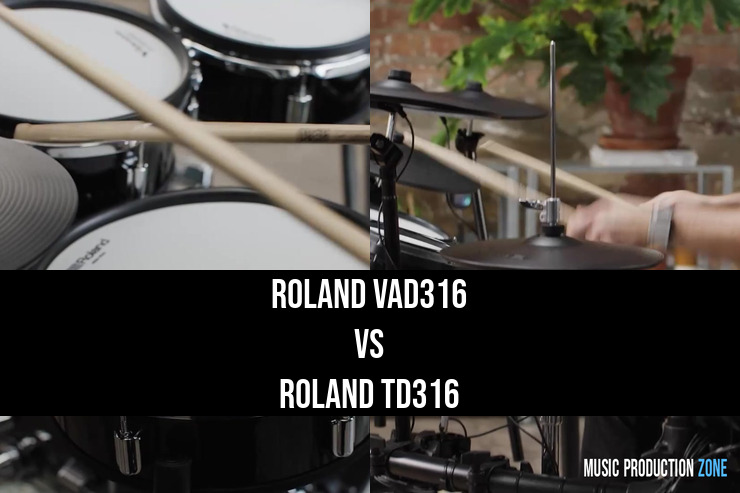
Roland VAD316 vs Roland TD316 (2026) Head to Head


Choose the Roland TD316 when you want a V31 kit that fits a smaller practice room. Choose the VAD316 when you want shallow wood shells, larger toms and a full-size kick drum arranged on acoustic-style stands. Both use the same module, so the VAD upgrade buys a different physical kit rather than a better recording connection or a new sound library.
The VAD316 also changes the snare design and enlarges the second crash and ride. Those are worth considering alongside appearance, especially if you are adapting an acoustic playing layout.
Key Differences
The TD316 has two 8-inch PD-8H toms and a 10-inch PD-10H. The VAD316 moves to two 10-inch PDA100L-BK toms and a 12-inch PDA120L-BK. Its shallow wood shells give the drums an acoustic-style appearance while avoiding the full depth of some larger VAD kits. The larger heads offer more room for your stick placement, but pad size alone does not prove superior triggering.
Both snares are 12 inches, though the models differ. The TD316 uses the PD-12P and the VAD316 uses the PDA120LS. Each has head and rim sounds with cross-stick articulation. Do not treat the VAD kit as the TD316 pads placed inside decorative shells: its named snare and tom hardware are different components.
The TD316's KD-10 is a kick tower with a 5-inch playing surface. The VAD316's KD-18-BK has an 18-inch wood shell. That shell changes the kit's presence and the space in front of your pedals. The shell diameter is not a measurement of the trigger area struck by your beater, so those two numbers are not a direct playing-surface comparison.
Both kits include a 12-inch CY-12C-T first crash. TD316 supplies another CY-12C-T and a 14-inch CY-14R-T ride. VAD316 supplies a 14-inch CY-14R-T second crash and a 16-inch CY-16R-T ride. The VAD ride gives you a larger target for bell, bow and edge playing. Its second crash is still configured for bow and edge sounds, even though that pad family can also serve as a ride.
The TD316 uses the MDS-Compact 2 rack. The VAD316 uses three DCS-30 combination stands and a PDS-5 module stand in Roland's standard configuration. Separate stands allow an acoustic-style arrangement, but their feet need floor space around the kit. Confirm the supplied stand package for your region, since Roland notes regional hardware differences.
Key Features in Common
Both kits include the 12-inch VH-10 hi-hat, which mounts on a conventional hi-hat stand and responds to pedal opening and closing. The stand is purchased separately. Both have three mesh toms, a mesh snare, two chokeable crashes and a three-zone ride.
The shared V31 means the same onboard sound engine, sample import, coaching tools, Bluetooth backing-track audio and editing options. You can play either kit without a laptop. The 4.3-inch colour display, EZ Edit controls and V31 computer editor are the same whichever hardware format you choose.
Both the Roland VAD316 and Roland TD316 are equipped with the same drum module (the V31), so your choice between the two e-drum sets will be based on your preferences between the drum pads, cymbals pads, and hardware on the separate kits.
Both kits can record up to 30 audio channels into a DAW over USB when the V31 is in vendor mode with the appropriate Roland driver. Generic USB mode records stereo. Buying the VAD316 does not unlock extra recording channels: that capability is already present in the TD316. Both also have stereo analog main outputs, with no dedicated direct-output sockets for separate drum feeds to a mixer.
Both standard configurations use the CRASH 2 input for their second crash, leaving the AUX/TOM 4 analog socket available. The V31's one digital input can support a compatible digital snare, ride or hi-hat; it cannot run all three simultaneously. Plan an upgrade around the pad you want most rather than assuming every premium Roland pad can be added at once.
Roland's example setups are about 1.5 by 1.1 metres for the TD316 and 1.865 by 1.4 metres for the VAD316, including the playing hardware and throne. Treat these as setup examples: cymbal angles and your preferred seated position change the final footprint. The larger VAD arrangement is a substantial difference if the room also contains a desk or other instruments.
Both packages require a kick pedal, snare stand, hi-hat stand, throne and monitoring. An SD card is also separate if you need the module's card-based functions. Measure the kit in its playing position and check your transport cases if it will travel regularly.
Price Comparison Between The Roland VAD316 and Roland TD316
Use the below to get up-to-date prices for both the Roland VAD316 and Roland TD316
Hi-Hat
Cymbal Pads
Toms
Drum Module
Snare
Kick
Verdict
The TD316 gives you the V31 workflow in a more compact arrangement. The VAD316 is worthwhile when the larger toms, larger ride and wood-shell layout suit the way you play and the room you have. The module and hi-hat are shared, so those should not be reasons to pay for the VAD hardware.
For a different module and digital pads, see Roland TD316 vs TD516. Our VAD516 vs TD516 comparison covers the same shell-versus-rack question in the V51 range.

Matt Taylor