
Our Verdict
Choose the RD-88 EX if you want Roland’s PHA-4 action, a broad sound library and a ready-made MainStage control profile. Choose the CK88 if battery power, organ drawbars and direct control of layered sounds matter more. Both handle wired computer recording, so your preferred action, sound and stage controls are better deciding factors than USB capability.
Roland RD-88 EX vs Yamaha CK88 (2026) Head to Head

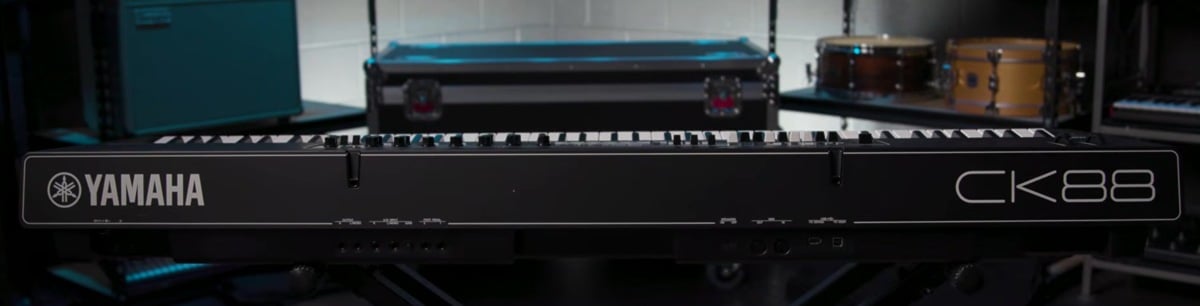
The Roland RD-88 EX and Yamaha CK88 bring weighted 88-key playing, built-in speakers and USB recording to a portable stage setup. Roland combines SuperNATURAL pianos with a large ZEN-Core sound library and dedicated MainStage integration. Yamaha adds organ drawbars, battery operation and Bluetooth audio for a flexible rehearsal or performance instrument.
Key Differences
| Feature | Roland RD-88 EX | Yamaha CK88 |
|---|---|---|
| Keyboard action | PHA-4 Standard; escapement and Ivory Feel | GHS; matte black keytops |
| Sound engine | SuperNATURAL Piano/E.Piano and ZEN-Core; Acoustic Piano 3 expansion included | AWM2 and AWM Organ Flutes |
| Sounds | Over 3000 tones; 400 scenes | 363 voices; 160 Live Set slots (80 preset) |
| Bluetooth audio | No built-in Bluetooth audio listed | Yes; input only, regional availability |
| Recording | USB audio/MIDI to computer; WAV/MP3 playback from USB; no internal song recorder listed | USB audio/MIDI to external recording software; no onboard song recorder listed |
| Power options | AC adaptor | AC adaptor or eight AA batteries |
| 5-pin MIDI ports | Out | In and Out |
| Physical organ drawbars | None | 9 |
| Weight | 13.5 kg excluding AC adaptor | 13.1 kg without batteries |
| Dimensions | 1284 x 258 x 159 mm (W x D x H) | 1333 x 354 x 148 mm (W x D x H) |
Keyboard: The RD-88 EX uses Roland’s PHA-4 Standard action with escapement and Ivory Feel surfaces. The CK88 uses Yamaha’s GHS action with matte black keytops. Both have weighted keys, but they are different mechanisms; try them before assuming either will suit your touch better.
Sound selection and controls: Roland combines SuperNATURAL acoustic and electric pianos with more than 3,000 tones, including the Acoustic Piano 3 expansion supplied in the EX model. Yamaha lists 363 voices and gives organ players nine physical drawbars, alongside part-volume, filter and envelope controls. The Roland offers more sound choices; the Yamaha’s layout is appealing if you reshape organ or layered sounds during a song. These are practical differences, not a score for sound quality.
Power and play-along audio: The CK88 can run on eight AA alkaline or rechargeable Ni-MH batteries as well as an adaptor. It also receives Bluetooth audio where that function is available. The RD-88 EX uses its AC adaptor and does not list built-in Bluetooth. Yamaha’s wireless audio is a way to bring tracks into the keyboard, not a replacement for wired stage monitoring.
Computer and MIDI rig: Both provide USB audio and MIDI. Roland offers a dedicated Apple MainStage profile and three zones for combining internal and external sounds. Yamaha has three internal sound parts, plus a master-keyboard function with up to four zones for controlling external tone generators. CK88 also has traditional MIDI In and Out; RD-88 EX has MIDI Out.
Pedals and transport: Roland includes its DP-10 damper pedal and has three pedal inputs. Yamaha’s standard package does not list a pedal and has two configurable pedal inputs. The RD-88 EX is 1,284 mm wide and 258 mm deep; the CK88 is 1,333 mm wide and 354 mm deep. Yamaha is slightly lighter at 13.1 kg without batteries, compared with Roland’s 13.5 kg excluding the adaptor. Case fit may matter more than that small weight difference.
Key Features in Common
| Feature | Roland RD-88 EX | Yamaha CK88 |
|---|---|---|
| Instrument type | Stage piano | Stage piano |
| Number of keys | 88 | 88 |
| Bluetooth MIDI | No built-in Bluetooth MIDI listed | No built-in Bluetooth MIDI listed |
| Weighted hammer-action keys | Yes | Yes |
| Audio recording over USB | Yes | Yes |
| MIDI over USB | Yes | Yes |
| Headphone sockets | 1 | 1 |
| Line output channels | 2 | 2 |
| Speaker amplification per side | 6 W | 6 W |
Both are self-contained 88-key instruments with built-in sounds, stereo speakers, layered and split playing, saved performance setups and effects. They can be used for practice without a computer, or connected to software instruments for a larger performance rig.
Each provides left/right 6.35 mm line outputs, a wired headphone socket, audio inputs and USB audio/MIDI. Both publish 6 W per side of speaker amplification. Roland uses full-range speakers plus tweeters; Yamaha uses two oval speakers. Amplifier ratings alone do not tell you how either will sound in your room or whether it will cover a venue.
Practical Buying Considerations
Recording and playback: Both can send their playing to compatible computer recording software over USB. That is separate from their USB flash-drive playback functions. Roland plays supported WAV/MP3 files; Yamaha plays supported WAV files. Yamaha explicitly says the CK88 cannot record directly to a USB drive. Plan to use a DAW or external recorder if you want to capture a rehearsal.
Required extras: Add a compatible sustain pedal to the Yamaha setup if you do not already own one, and check the local package’s adaptor inclusion. For a band or a larger room, plan for the PA or powered monitoring you need.
Exact models: This comparison uses the factory RD-88 EX and weighted 88-key CK88. An original RD-88 can receive an EX upgrade, but do not assume an unupgraded used RD-88 includes the same expansion. The CK61 has a different keyboard action and key count, so its playing feel and transport figures should not be substituted here.
Full Specifications
Keyboard and sound
| Feature | Roland RD-88 EX | Yamaha CK88 |
|---|---|---|
| Instrument type | Stage piano | Stage piano |
| Number of keys | 88 | 88 |
| Keyboard action | PHA-4 Standard; escapement and Ivory Feel | GHS; matte black keytops |
| Sound engine | SuperNATURAL Piano/E.Piano and ZEN-Core; Acoustic Piano 3 expansion included | AWM2 and AWM Organ Flutes |
| Maximum polyphony | Not specified | 128 notes |
| Sounds | Over 3000 tones; 400 scenes | 363 voices; 160 Live Set slots (80 preset) |
Speakers and pedals
| Feature | Roland RD-88 EX | Yamaha CK88 |
|---|---|---|
| Built-in speakers | 2 x 6 W; two 12 cm full-range speakers plus two 2 cm tweeters | 2 x 6 W; two 12 x 6 cm speakers |
| Pedal support | DP-10 damper included; three pedal inputs | Two configurable pedal inputs; pedals sold separately |
| Included equipment | DP-10 damper, AC adaptor, power cord | Owner manual; AC adaptor inclusion varies by region |
| Optional equipment | Stand, bench/case separate; original RD-88 upgrade path must not be confused with factory EX model | Eight AA battery operation; drawbars; stand, pedal, bench/case optional |
Recording and connectivity
| Feature | Roland RD-88 EX | Yamaha CK88 |
|---|---|---|
| USB audio | Yes | Yes; stereo in/out at 44.1 kHz |
| USB MIDI | Yes; MIDI Out also provided | Yes; MIDI In/Out also provided |
| Bluetooth audio | No built-in Bluetooth audio listed | Yes; input only, regional availability |
| Bluetooth MIDI | No built-in Bluetooth MIDI listed | No built-in Bluetooth MIDI listed |
| Outputs | L/Mono and R 6.35 mm outs; 6.35 mm headphone jack | L/Mono and R 6.35 mm unbalanced outs; 6.35 mm headphones |
| Recording | USB audio/MIDI to computer; WAV/MP3 playback from USB; no internal song recorder listed | USB audio/MIDI to external recording software; no onboard song recorder listed |
| Splits, layers and performance | Three parts/zones; split and layer | Three sound parts; split and layer; four MIDI zones |
Comparison essentials
| Feature | Roland RD-88 EX | Yamaha CK88 |
|---|---|---|
| Weighted hammer-action keys | Yes | Yes |
| Audio recording over USB | Yes | Yes |
| MIDI over USB | Yes | Yes |
| Headphone sockets | 1 | 1 |
| Line output channels | 2 | 2 |
| Speaker amplification per side | 6 W | 6 W |
| Power options | AC adaptor | AC adaptor or eight AA batteries |
| 5-pin MIDI ports | Out | In and Out |
| Physical organ drawbars | None | 9 |
Portability
| Feature | Roland RD-88 EX | Yamaha CK88 |
|---|---|---|
| Weight | 13.5 kg excluding AC adaptor | 13.1 kg without batteries |
| Dimensions | 1284 x 258 x 159 mm (W x D x H) | 1333 x 354 x 148 mm (W x D x H) |
Verdict
The RD-88 EX is a strong fit for a piano-centred rig that also needs a large library and MainStage control. The CK88 suits players who want battery-powered rehearsals, organ drawbars and a broad range of directly adjustable sounds. With USB recording on both, choose around the music you play and the controls you need within reach, then compare their actions and piano tones in person.