
Our Verdict
Choose the P-145BT for a simple weighted-key piano with Bluetooth backing-track playback and USB recording. Choose the P-225 for its CFX piano sound, split mode, two-track internal recorder or separate outputs for external speakers. Both cover the basics; the P-225's extra facilities suit a more varied practice or performance routine.
Yamaha P-145BT vs Yamaha P-225 (2026) Head to Head
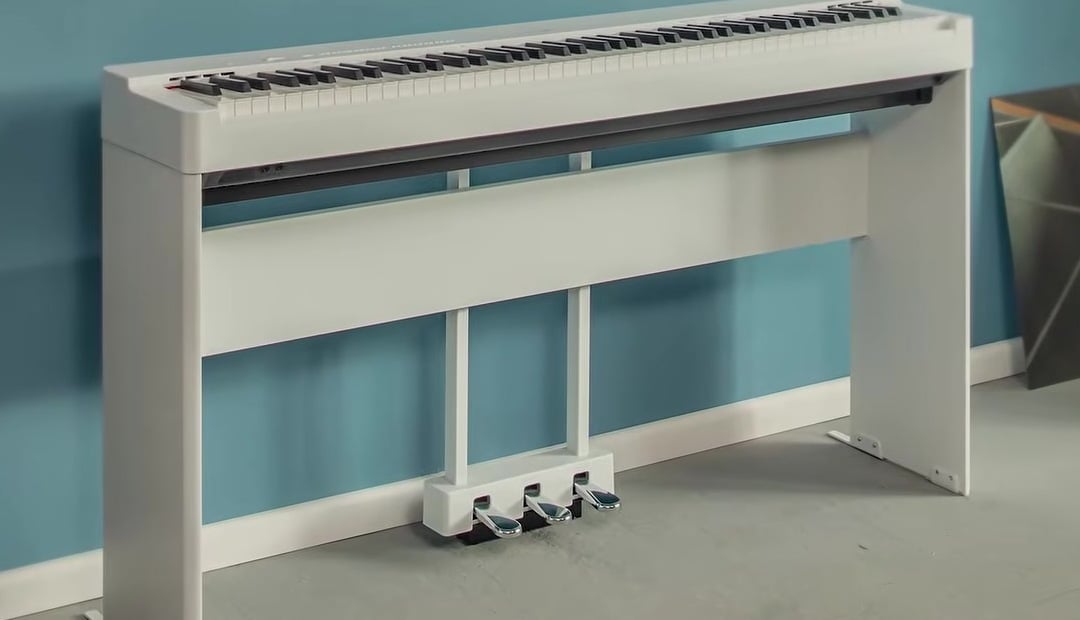
Yamaha P-225
Shown in white with the optional stand and pedal unit. The linked product is the black instrument alone.
View PriceThe Yamaha P-145BT and P-225 are compact digital pianos with 88 weighted keys, built-in speakers and USB audio. Both support home practice and recording, but the P-225 adds a different piano sound, more practice and performance features, and dedicated line outputs. This comparison concerns the Bluetooth-equipped P-145BT, rather than the earlier P-145.
Key Differences
| Feature | Yamaha P-145BT | Yamaha P-225 |
|---|---|---|
| Sound engine | Yamaha CFIIIS samples; damper resonance | Yamaha CFX samples; VRM Lite resonance |
| Maximum polyphony | 64 notes | 192 notes |
| Sounds | 10 | 24 |
| Bluetooth MIDI | No built-in Bluetooth MIDI | No built-in; optional UD-BT01 for compatible iOS connections |
| Recording | No onboard recorder listed; connected software/app recording | One-song, two-track MIDI recorder; approximately 11000 notes |
| Headphone sockets | 1 | 2 |
| Line output channels | 0 | 2 |
| Weight | 11.1 kg | 11.5 kg |
| Dimensions | 1326 x 268 x 129 mm (W x D x H) | 1326 x 272 x 129 mm (W x D x H), music rest detached |
Piano sound: The P-145BT uses Yamaha CFIIIS piano samples and damper resonance. The P-225 uses the CFX concert-grand sound with VRM Lite. Listen to both through the same headphones if possible: a different source piano and resonance system do not establish which tone you will prefer.
Sounds and headroom: The P-145BT has 10 voices and 64-note maximum polyphony; the P-225 has 24 voices and 192-note maximum polyphony. The P-225 also adds split mode and rhythm accompaniment. More polyphony can help with sustained or layered playing, while the additional voices are useful if you want to move beyond acoustic piano.
Practice recording: The P-225's two-track MIDI recorder lets you record one hand and practise the other alongside it. The P-145BT relies on a connected app or software for recording. Both can send their onboard sound over USB, so the simpler piano still has a route into computer recording.
Outputs and speakers: The P-225 has two headphone sockets and separate left/right AUX outputs. The P-145BT has one headphone socket and no dedicated line outputs. Both specify 7 W amplification per side, but the P-225 adds tweeters and further sound-processing options. Equal wattage does not imply identical speaker reproduction.
Key Features in Common
| Feature | Yamaha P-145BT | Yamaha P-225 |
|---|---|---|
| Instrument type | Portable digital piano | Portable digital piano |
| Number of keys | 88 | 88 |
| Keyboard action | GHC (Graded Hammer Compact); matte black keytops | GHC (Graded Hammer Compact); matte black keytops |
| Bluetooth audio | Yes; input only, regional availability | Yes; input only, regional availability |
| Weighted hammer-action keys | Yes | Yes |
| Audio recording over USB | Yes | Yes |
| MIDI over USB | Yes | Yes |
| Speaker amplification per side | 7 W | 7 W |
| Power options | AC adaptor | AC adaptor |
| 5-pin MIDI ports | None | None |
| Physical organ drawbars | None | None |
Both have Yamaha's GHC weighted keyboard, layer and Duo modes, a metronome and USB MIDI. Bluetooth audio brings music from a compatible device into the piano where the feature is available. Neither has built-in Bluetooth MIDI or a Bluetooth headphone transmitter.
Both offer sustain-pedal and compatible pedal-unit connections. The shared USB audio feature makes either usable for recording its internal sounds, while USB MIDI can control a software instrument instead.
Practical Buying Considerations
Recording format: The P-145BT's USB audio is stereo 44.1 kHz/16-bit; the P-225 provides stereo 44.1 kHz/24-bit. Select the matching format in your software. The higher bit depth offers more recording headroom, but does not replace good playing, sensible levels or a suitable monitoring setup.
Room and portability: The instruments have similar footprints. Yamaha lists the P-145BT at 11.1 kg and the P-225 at 11.5 kg. For regular moves, the stand, pedal equipment and case can make a bigger practical difference than this small instrument-weight gap.
Accessories: Confirm the exact regional package and compatible stand/pedal combination. Include a comfortable bench in your setup, and use wired headphones for practice. Check Bluetooth availability in your market before relying on wireless backing tracks.
Full Specifications
Keyboard and sound
| Feature | Yamaha P-145BT | Yamaha P-225 |
|---|---|---|
| Instrument type | Portable digital piano | Portable digital piano |
| Number of keys | 88 | 88 |
| Keyboard action | GHC (Graded Hammer Compact); matte black keytops | GHC (Graded Hammer Compact); matte black keytops |
| Sound engine | Yamaha CFIIIS samples; damper resonance | Yamaha CFX samples; VRM Lite resonance |
| Maximum polyphony | 64 notes | 192 notes |
| Sounds | 10 | 24 |
Speakers and pedals
| Feature | Yamaha P-145BT | Yamaha P-225 |
|---|---|---|
| Built-in speakers | 2 x 7 W; two 12 x 8 cm oval speakers | 2 x 7 W; two 12 x 8 cm oval speakers plus two 5 cm tweeters |
| Pedal support | Footswitch included; sustain and pedal-unit inputs; compatible half-pedal accessories optional | Footswitch included; optional FC3A half-pedal and LP-1 triple pedal unit |
| Included equipment | Music rest and footswitch; AC adaptor inclusion varies by region | Music rest, footswitch; AC adaptor inclusion varies by region |
| Optional equipment | Stand, bench and triple-pedal unit optional; BT generation distinct from P-145 | Optional L-200 stand, LP-1 pedal unit, FC3A sustain pedal, bench/case |
Recording and connectivity
| Feature | Yamaha P-145BT | Yamaha P-225 |
|---|---|---|
| USB audio | Yes; 44.1 kHz/16-bit stereo | Yes; 44.1 kHz/24-bit stereo |
| USB MIDI | Yes | Yes |
| Bluetooth audio | Yes; input only, regional availability | Yes; input only, regional availability |
| Bluetooth MIDI | No built-in Bluetooth MIDI | No built-in; optional UD-BT01 for compatible iOS connections |
| Outputs | One 6.35 mm stereo headphone jack; no dedicated line outs | L/L+R and R 6.35 mm AUX outs; two 6.35 mm headphone jacks |
| Recording | No onboard recorder listed; connected software/app recording | One-song, two-track MIDI recorder; approximately 11000 notes |
| Splits, layers and performance | Layer and Duo; no split | Layer, split and Duo |
Comparison essentials
| Feature | Yamaha P-145BT | Yamaha P-225 |
|---|---|---|
| Weighted hammer-action keys | Yes | Yes |
| Audio recording over USB | Yes | Yes |
| MIDI over USB | Yes | Yes |
| Headphone sockets | 1 | 2 |
| Line output channels | 0 | 2 |
| Speaker amplification per side | 7 W | 7 W |
| Power options | AC adaptor | AC adaptor |
| 5-pin MIDI ports | None | None |
| Physical organ drawbars | None | None |
Portability
| Feature | Yamaha P-145BT | Yamaha P-225 |
|---|---|---|
| Weight | 11.1 kg | 11.5 kg |
| Dimensions | 1326 x 268 x 129 mm (W x D x H) | 1326 x 272 x 129 mm (W x D x H), music rest detached |
Verdict
The P-145BT is a focused option for learning and everyday practice that still supports USB recording. The P-225 is more flexible for split playing, internal practice recording and connecting to a PA. Choose around those uses, then let your preference for the piano sound guide the final decision.
Yamaha P-225
Shown in white with the optional stand and pedal unit. The linked product is the black instrument alone.
View Price