
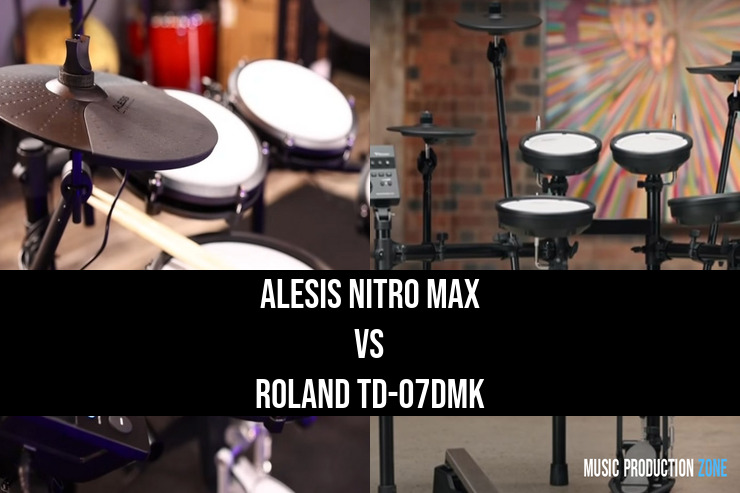
The Nitro Max is our pick for a first kit when you want useful pad sizes and fewer extras to buy. The TD-07DMK is the stronger choice if you plan to record its own sounds directly into a computer or want bow and edge articulation on the cymbals. Budget for a separate kick pedal with the Roland, and decide whether its smaller toms suit your playing before paying for the module upgrade.
Alesis Nitro Max vs Roland TD-07DMK (2026) Head to Head


Choose the Alesis Nitro Max if you want larger mesh playing surfaces, an included kick pedal and room to add a fourth tom. Choose the Roland TD-07DMK if stereo USB recording, cymbal edge sounds and more detailed sound editing matter more to you.
Both have a mesh snare and three mesh toms. The Roland upgrade is mainly about the module and triggering options, rather than simply getting mesh heads. The Nitro Max gives you a complete five-piece drum arrangement with a separate kick tower; the TD-07DMK keeps its kick pad mounted low on the rack.
Key Differences
Nitro Max has a 10-inch dual-zone snare and three 8-inch single-zone mesh toms. TD-07DMK uses the PDX-8 snare with an 8-inch mesh playing head and three 6-inch PDX-6A mesh toms. The larger frame around the PDX-8 should not be confused with its head diameter. Both snares support separate head and rim sounds, but neither set of included toms gives you tom-rim triggering.
The Nitro Max's larger tom targets leave more room for a beginner's stick placement. Roland's two-ply mesh heads let you adjust rebound through head tension, as you can with the Alesis mesh pads. Head construction and trigger settings matter alongside size; a larger diameter alone does not settle the question of playing response.
Nitro Max comes with a kick tower and a conventional pedal. Roland supplies the rack-mounted KD-2 kick pad, but you provide the pedal. Its pad supports double-pedal use, whereas the smaller Nitro Max tower is best treated as a single-pedal setup. Allow space for the Alesis tower in front of the rack, and use a mat to help keep the pedal and tower in place.
Both have 10-inch hi-hat, crash and ride pads. The Roland CY-5 cymbals support bow and edge triggering. Nitro Max's cymbals are single-zone, with choke support on the crash. These are more useful distinctions than diameter if you want different sounds from the edge of a cymbal.
TD-07 sends stereo audio and MIDI over USB. Nitro Max sends MIDI, so recording the Alesis module's own sounds requires an audio interface connected to its analog output. Either kit can trigger drum software on a computer; that software's sounds are separate from the module's onboard library.
The Alesis Nitro Max is equipped with the Nitro Max Drum Module, while the Roland TD-07DMK uses the TD-07.
Key Features in Common
Both kits work without a computer, include a rack and use a separate controller pedal for the hi-hat. Neither includes a moving hi-hat on an acoustic stand. The pedals provide intermediate hi-hat control, so the choice is not simply an open/closed switch versus a full hi-hat system.
Bluetooth audio is built into both modules for playing along with music. Listen to your live drums through wired headphones or speakers: receiving music over Bluetooth does not mean the module transmits your playing to Bluetooth headphones.
Both modules include a metronome and practice functions. Both let you alter onboard kit settings, although the TD-07 gives you more control over the character of each instrument and its effects.
Check out the Alesis Nitro Max in action.
And here's a video of the Roland TD-07DMK.
TD-07's editing includes tuning, muffling, pad EQ, ambience and multi-effects. That suits a player who wants to shape a small set of preferred kits. Nitro Max lets you select voices and adjust their level and other settings, with 32 factory kits and 16 user slots. Neither imports your own audio samples.
For Roland USB audio, select vendor mode and install the appropriate Roland driver. The resulting recording is stereo, rather than a separate audio track for every drum. Nitro Max's USB MIDI can drive a software instrument in your DAW, where you monitor the computer's sound output. These are different recording routes, even though both start with a USB cable.
Nitro Max has separate Tom 4 and Crash 2 expansion inputs. TD-07DMK's cable harness supports another crash; the extra pad and mount are separate purchases. Neither module supports Roland's digital snare, ride or hi-hat pads, so a later digital-pad upgrade needs a different module too.
Roland lists an example setup of about 1.2 by 1.1 metres including a throne; Alesis describes the assembled Nitro Max as roughly 4 by 3 feet. These estimates use different setup assumptions. Leave additional room to sit, move your arms and get behind the kit.
The standard Nitro Max includes sticks and both pedals. TD-07DMK includes its hi-hat controller but needs a kick pedal. Both need a throne and headphones or a monitor. The Roland combines its headphone and speaker output in one stereo mini jack; Nitro Max has a separate quarter-inch stereo audio output and headphone socket.
Price Comparison Between The Alesis Nitro Max and Roland TD-07DMK
Use the below to get up-to-date prices for both the Alesis Nitro Max and Roland TD-07DMK
Hi-Hat
Cymbal Pads
Toms
Drum Module
Snare
Kick
Overview
Verdict
Buy Nitro Max for larger mesh targets, an included kick pedal and straightforward tom-and-crash expansion. Buy TD-07DMK for its stereo USB audio, dual-zone cymbals and sound editing if those benefits justify the smaller toms and extra pedal purchase.
For another Roland starter option, see Roland TD-02KV vs Alesis Nitro Max. If you want to move up within Alesis, read Nitro Max vs Nitro Pro.

Matt Taylor