
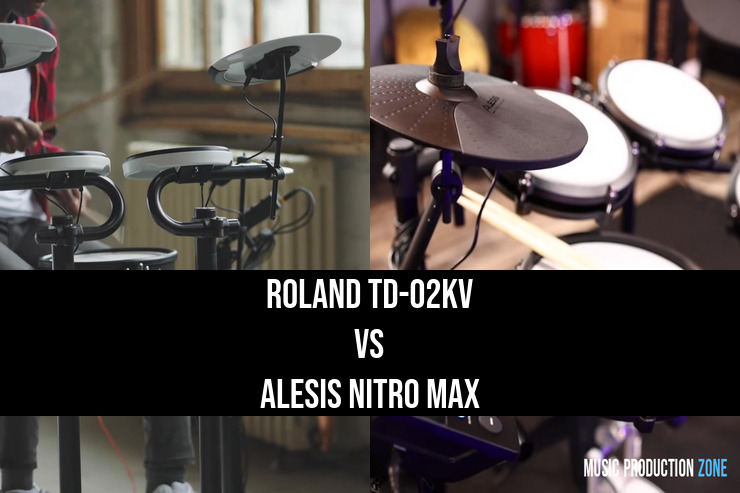
Nitro Max is our choice for a beginner whose priority is practicing on mesh drums with a conventional kick pedal. Choose TD-02KV when avoiding a beater striking a kick pad, keeping the module simple or recording its sounds over USB is more useful. Neither choice makes a room silent, and the Roland's included kick controller does not reproduce the mechanical action of a bass-drum pedal.
Roland TD-02KV vs Alesis Nitro Max (2026) Head to Head


The Roland TD-02KV suits a beginner who wants a simple practice kit with a beaterless kick pedal and stereo USB recording. The Alesis Nitro Max suits someone who wants mesh toms, a larger snare and a conventional bass-drum pedal from the start.
TD-02KV has one mesh drum head, on its snare, while Nitro Max has mesh heads across the snare and all three toms. Both supply the two foot controllers you need to start playing, but the kick action and the route into computer recording differ substantially.
Key Differences
Roland supplies the KT-1 kick trigger pedal. It has no separate beater or kick tower, so it removes one source of pad impact from the setup. Nitro Max supplies a conventional pedal and a separate kick tower. The Alesis lets you practice moving a beater against a pad; the Roland is easier to choose when that impact is something you want to avoid.
Stick hits and pedal movement can still travel through a floor with either kit. Headphones reduce the amplified drum sound, but they do not remove physical playing noise. A mat helps stop hardware sliding; it does not guarantee that a downstairs neighbour will hear nothing.
TD-02KV's PDX-8 snare has an 8-inch mesh playing head, with a larger surrounding rim frame. Nitro Max has a 10-inch dual-zone mesh snare. Both support head and rim sounds. The Roland's three PD-4 toms are rubber, while the Nitro Max has three 8-inch mesh toms whose tension you can adjust. Both sets of toms are single-zone.
The Roland CY-5 hi-hat, crash and ride pads are 10-inch bow/edge cymbals. Nitro Max also uses 10-inch cymbals, but they are single-zone; its crash supports choking. Roland therefore gives you more cymbal articulations even though it supplies fewer mesh drum surfaces.
TD-02 has 16 fixed drum kits. Nitro Max has 32 factory kits plus 16 slots for edited user kits. The Alesis is more suitable if you want to assign different voices and save your own arrangements. The Roland keeps sound selection simpler, leaving more of the beginner's attention on playing.
Nitro Max has built-in Bluetooth audio. TD-02KV needs the optional BT-DUAL adapter for Bluetooth audio and MIDI. You can still play music into either module through a cable connected to its mix or auxiliary input.
The Roland TD-02KV is equipped with the TD-02, while the Alesis Nitro Max uses the Nitro Max Drum Module.
Key Features in Common
Both kits provide a snare, three toms, hi-hat, crash and ride around a four-post rack. Both include a separate hi-hat controller pedal, rather than a moving hi-hat on a stand. Both make their own drum sounds without needing a computer.
Each module includes a metronome and timing exercises for practice. Each can send USB MIDI to music software, so you can use a computer drum instrument when you want a different sound library. Neither kit requires that software for ordinary headphone practice.
Both use wired headphone connections. Nitro Max's Bluetooth and the optional Roland adapter receive backing-track audio; they do not provide a wireless headphone output for monitoring your playing.
And here's a video of the Alesis Nitro Max.
TD-02KV can record its onboard sounds as stereo USB audio when you select vendor mode and install Roland's driver. Nitro Max's USB connection carries MIDI only. To record its own sound engine, connect its analog audio output to an interface. To record a software drum instrument instead, use USB MIDI and monitor the computer.
Nitro Max has a separate quarter-inch stereo audio output alongside its headphone socket. Roland uses one combined stereo mini OUTPUT/PHONES jack for headphones or a powered speaker. Plan the cable connection if you want to amplify either kit; neither includes speakers.
For expansion, Nitro Max has Tom 4 and Crash 2 inputs. TD-02KV supports another crash through the spare harness connection, and Roland lists KD-series kick pads as optional alternatives to the KT-1. Changing the Roland kick setup means adding a compatible pad and conventional pedal; those are not included in the standard kit. Neither module accepts Roland's USB digital pads.
Roland's example TD-02KV setup measures about 1.2 by 1.1 metres including the throne. Alesis describes Nitro Max as around 4 by 3 feet, with arrangement affecting the final size. Allow space for your stool and for the Alesis kick tower rather than choosing from rack width alone.
Nitro Max includes sticks, the kick pedal and hi-hat controller. Roland supplies its KT-1 and FD-1 pedals but excludes sticks. Both still need a throne and headphones or another monitoring system. An optional Bluetooth adapter should be counted separately when comparing the Roland package.
Price Comparison Between The Roland TD-02KV and Alesis Nitro Max
Use the below to get up-to-date prices for both the Roland TD-02KV and Alesis Nitro Max
Hi-Hat
Cymbal Pads
Toms
Drum Module
Snare
Kick
Overview
Verdict
Choose Nitro Max if mesh toms, a larger snare and conventional kick practice are your main requirements. Choose TD-02KV for the beaterless controller, simpler kit selection and stereo USB recording. If you want the Roland recording route with mesh toms and a beater-driven kick, compare the Nitro Max and TD-07DMK before deciding.
The Nitro Max vs Nitro Pro guide covers an Alesis upgrade with more capable pad hardware.

Matt Taylor