
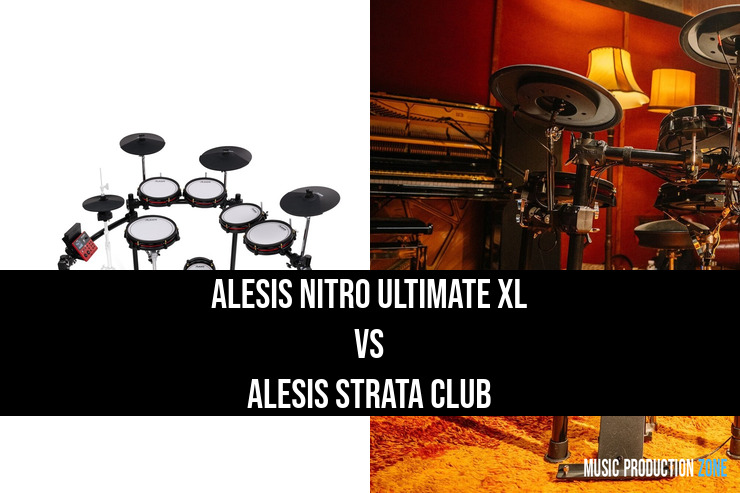
Strata Club is our pick for a drummer who is happy with a two-tom layout and wants deeper sound design from the module itself. Nitro Ultimate XL is the better fit when four toms and two crashes are part of how you play. Adding more pads to Club later is possible, but it adds expense and hardware to a kit chosen for its simpler layout.
Alesis Nitro Ultimate XL vs Alesis Strata Club (2026) Head to Head
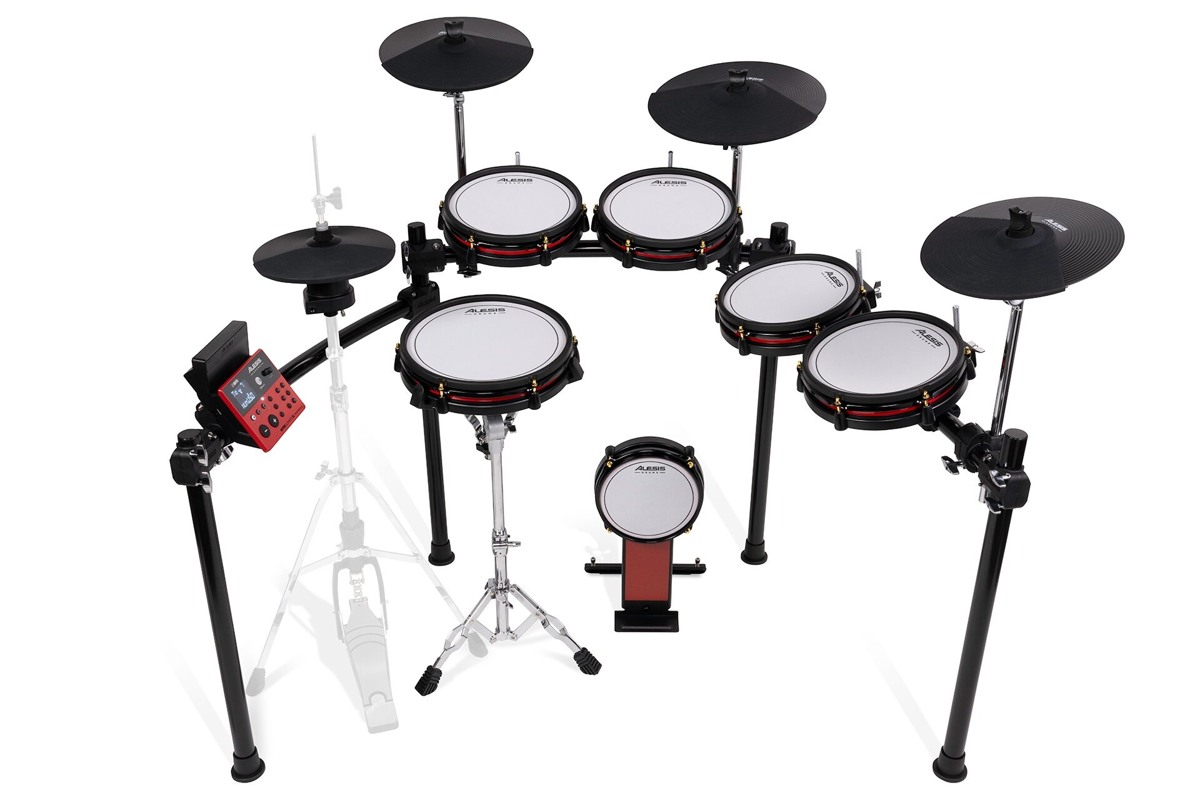

Choose the Alesis Nitro Ultimate XL if you want four toms and two crashes ready to arrange around the rack. Choose Strata Club if two toms and one crash are enough and you would put the upgrade budget into cymbal control and the Core module's sound editing.
Both have a 12-inch mesh snare and a 14-inch three-zone ride. Strata Club's smaller pad count can therefore be misleading: it is a different balance of playing layout, cymbal technology and module features.
Key Differences
Nitro Ultimate XL supplies four 10-inch dual-zone mesh toms. Strata Club has two 10-inch dual-zone mesh toms. Both have a 12-inch dual-zone mesh snare, so Club's reduction is in the number of tom positions rather than the size of the snare or tom heads.
XL also supplies two 12-inch dual-zone crashes. Club has one 12-inch ARC crash, with three zones and a playing surface that works around the full cymbal. Club's ARC ride and hi-hat also offer bow, edge and bell triggering. Both rides are 14 inches and three-zone, but the cymbal systems and strike coverage differ.
The hi-hat is 10 inches on XL and 12 inches on Club. Both use a conventional hi-hat stand bought separately. Club uses an active magnetic controller powered by the Core module, together with its ARC cymbal. Treat the hi-hat and controller as a matched system rather than assuming either will be a direct replacement on the Nitro module.
The Core module has a 7-inch colour touchscreen. It lets you assemble kits, layer instruments, work with microphone and ambience levels, and use processing such as EQ and compression. Nitro Ultimate XL uses buttons and a small segment display for selecting voices and adjusting parameters such as pitch, volume, reverb and EQ.
Core runs its BFD sound engine inside the module, with a substantial onboard sample library. The Nitro module has its own onboard sounds, while the bundled BFD Player runs on a separate computer. You can practice without a computer on either kit, but buying Nitro does not put the computer software's library inside its module.
Club's module also supports importing audio files from USB storage and recording audio through Jam Mode. XL's internal recorder captures performance data and it has no user audio sample import. Club is more useful if you want to build a kit around your own sounds without keeping a laptop attached.
The Alesis Nitro Ultimate XL is equipped with the Nitro Ultimate XL, while the Alesis Strata Club uses the Core.
Key Features in Common
Both kits have tension-adjustable mesh snare and tom heads, separate head and rim triggering on those drums, and an 8-inch mesh kick tower. Both kick towers accommodate a double pedal. The smaller Club layout still uses full drum pads rather than replacing its toms with compact rubber triggers.
Each has Bluetooth audio and a wired auxiliary input for playing along with music. Each can send USB MIDI to a computer drum instrument and works as a standalone kit through wired headphones or powered amplification.
Neither offers direct USB audio streaming for recording the module's drum sound into a DAW. Use the analog main outputs and an audio interface for that job. Core's USB storage and audio-file features do not mean its computer USB connection carries multitrack drum audio.
Choose the layout before counting sounds. A player who regularly uses four toms will notice two missing pads immediately on Club. A player who spends most of a song on kick, snare and hi-hat may get more use from Club's cymbal response and module controls than from two additional toms.
Both kits supply a separate snare stand. Club has fewer pads to place around its rack. XL's extra toms and crash give you more positions to reach. Leave room for the throne, kick pedal and hi-hat stand on either setup; a compact rack is only part of the total playing footprint.
The linked Thomann Ultimate XL kit excludes a kick pedal, hi-hat stand, throne and headphones. Strata Club also needs a kick pedal, hi-hat stand, throne and monitoring. The Club snare stand is included. Check an accessory bundle against this list rather than assuming every product photograph shows everything supplied.
XL's Tom 4 and Crash 2 sockets are used by its supplied pads. Club has Tom 4 and Cymbal 3 expansion connections as well as its cable harness, and Alesis offers a Club expansion pack. Any expansion needs compatible pads, mounts and cables; do not assume the two modules accept identical accessories.
For computer software, USB MIDI lets you record the performance and change drum sounds later. Use the computer or audio interface for headphone monitoring when the software is making the sound. For playing the onboard kits, plug headphones into the module instead.
Club provides DIN MIDI input and output as well as USB and Bluetooth MIDI, which is useful when connecting other MIDI hardware. XL's MIDI connection is USB. Neither kit's Bluetooth music input replaces a wired monitoring connection for live playing.
Price Comparison Between The Alesis Nitro Ultimate XL and Alesis Strata Club
Use the below to get up-to-date prices for both the Alesis Nitro Ultimate XL and Alesis Strata Club
Hi-Hat
Cymbal Pads
Toms
Drum Module
Snare
Kick
Overview
Verdict
Buy Nitro Ultimate XL when the larger four-tom, two-crash layout is the priority. Buy Strata Club when two toms and one crash cover your parts and the Core module, ARC cymbals and active hi-hat are the upgrades you want. Club is the more flexible sound-building system; XL supplies more playing positions from the start.
For the smaller Nitro option, see Nitro Ultimate vs Nitro Ultimate XL. For the larger kit with Club's module, read Strata Club vs Strata Core.

Matt Taylor