
We would choose Nitro Ultimate XL for a player who wants a larger acoustic-style layout and uses the ride bell regularly. The standard Ultimate is a sensible buy when three toms are enough and you prefer smaller targets around the rack. Both still use USB MIDI rather than USB audio, so the XL hardware upgrade does not remove the need for an audio interface when recording the module's own sounds.
Alesis Nitro Ultimate vs Alesis Nitro Ultimate XL (2026) Head to Head

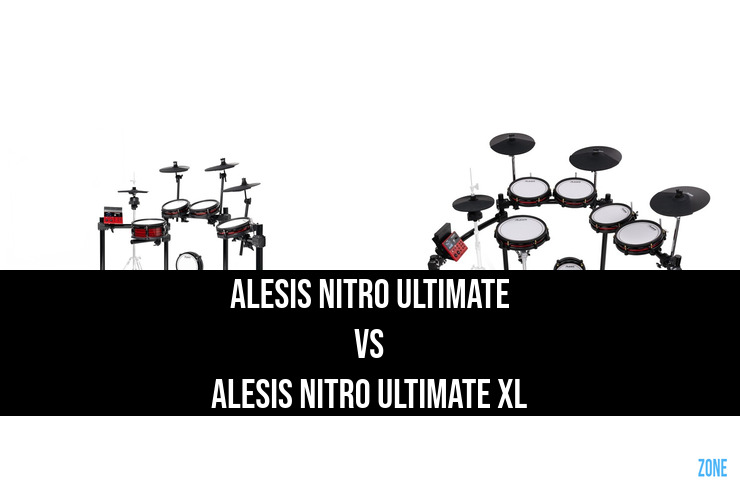
The Alesis Nitro Ultimate XL is the better choice if you want larger drum pads, four toms and a separate ride-bell zone. Choose the standard Nitro Ultimate if its three-tom layout and smaller pads suit your playing space.
This XL upgrade changes more than the number of pads. The snare grows from 10 to 12 inches, the toms from 8 to 10 inches, and the cymbals also get larger. Both kits already have a movable hi-hat for a conventional stand, so you do not need XL just to get that feature.
Key Differences
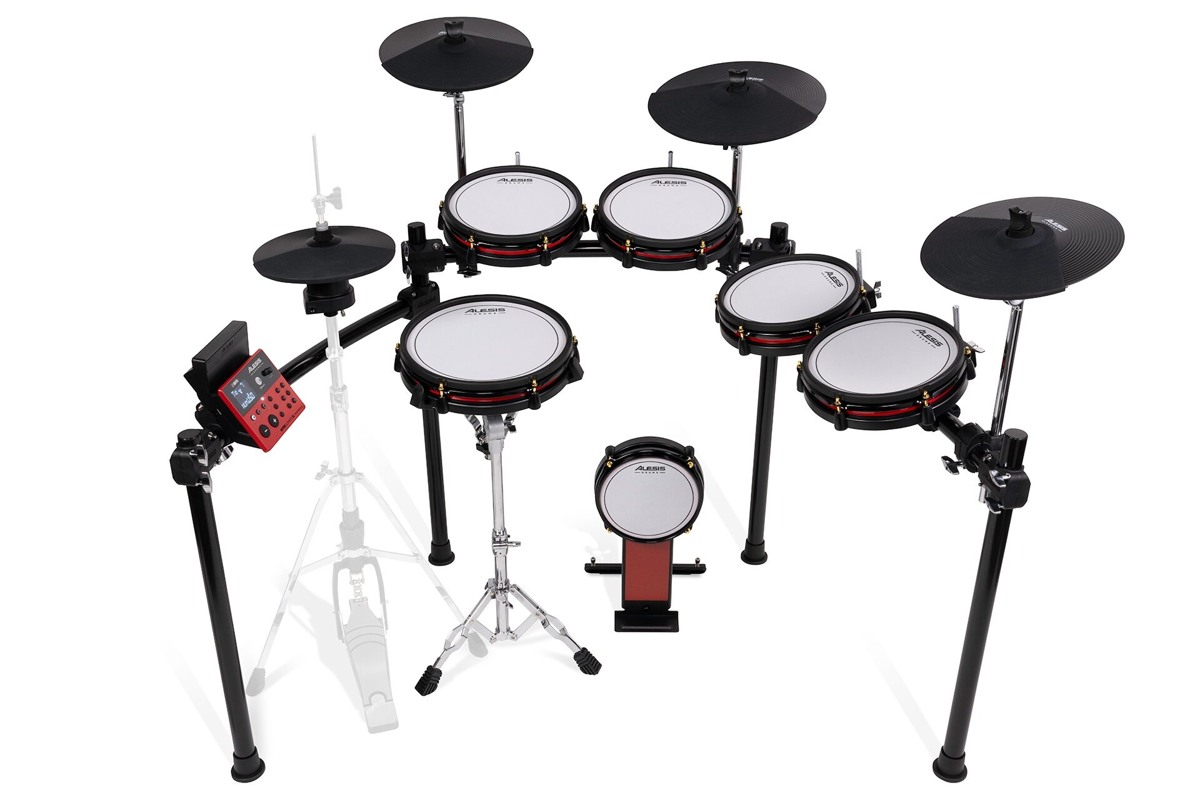
The standard Ultimate has a 10-inch dual-zone mesh snare and three 8-inch dual-zone mesh toms. XL has a 12-inch dual-zone snare and four 10-inch dual-zone toms. The larger heads give you more room to place strokes, while the fourth tom adds another position for fills. Head tension remains adjustable on either kit. The standard snare mounts to the rack; XL supplies a separate snare stand, giving you more freedom to position it independently.
XL's 14-inch ride has separate bow, edge and bell zones. The standard kit's 10-inch ride is dual-zone. This makes XL the more useful arrangement for parts that alternate between the ride bow and bell: you can use the bell area as its own trigger rather than giving up another playing zone to assign that sound.
Both kits include two crashes. They are 10 inches on the standard Ultimate and 12 inches on XL, with dual-zone triggering and choke functions. Unlike the Nitro Pro XL upgrade, Ultimate XL does not add a second crash to a one-crash standard kit.
The modules have their own Ultimate and Ultimate XL names, with a dedicated XL configuration for the expanded pads and ride. Both provide 36 factory kits and 16 user-kit slots, sound assignment, pitch adjustment, reverb and three-band EQ. The reason to choose XL is primarily its playing hardware; it does not bring a touchscreen or a different recording workflow.
The XL uses the Tom 4 input for its fourth tom. Both versions use the Crash 2 connection for the supplied second crash. The standard Ultimate therefore has a straightforward spare tom connection, while XL arrives with that addition already fitted. Do not count both expansion sockets as unused just because the module has two extra jacks.
The Alesis Nitro Ultimate is equipped with the Nitro Ultimate, while the Alesis Nitro Ultimate XL uses the Nitro Ultimate XL.
Key Features in Common
Both kits have an 8-inch mesh kick tower that can accommodate a double pedal, and both use mesh heads on the snare and toms. The drum pads have head and rim zones. A larger mesh head changes the available playing area, but size alone does not establish a better trigger response.
Both include a 10-inch dual-zone hi-hat and a controller that mounts on a conventional hi-hat stand. The stand is a separate purchase. This gives you a moving hi-hat under your left foot instead of a fixed pad with a separate floor controller.
Both work without a computer. Each has Bluetooth audio for backing tracks, a wired auxiliary input, a metronome and practice functions. Connect wired headphones to hear your playing; Bluetooth is for receiving music, not sending live drums to wireless headphones.
USB carries MIDI on both modules. To use a computer drum instrument, connect the kit by USB and let the software produce the sound. Monitor that software through the computer or audio interface. Its audio does not return through the Nitro module's headphone socket over USB.
To record the onboard drum sounds, connect the module's analog outputs to an audio interface. The internal performance recorder stores a short sequence of playing data; it does not turn the kit into a USB audio recorder. Neither module imports your own audio samples.
Check the exact hardware package before ordering. The standard manufacturer's Ultimate specification includes a kick pedal, while the linked Thomann Ultimate XL kit excludes the foot pedal. Both need a hi-hat stand, a throne and headphones or a monitor. Support for a double pedal does not mean a double pedal is included.
Allow space for your seat, both feet and comfortable stick movement. Four larger toms need more careful placement than three smaller ones. If you are fitting a kit between furniture, map out the playing positions before assuming the XL rack will work in the same spot.
Both hi-hats require correct controller assembly and calibration. Tighten the stand's pull rod and position the striking surface within reach. A movable hi-hat is useful practice hardware, but it still needs setup rather than behaving correctly with any arbitrary stand adjustment.
Price Comparison Between The Alesis Nitro Ultimate and Alesis Nitro Ultimate XL
Use the below to get up-to-date prices for both the Alesis Nitro Ultimate and Alesis Nitro Ultimate XL
Hi-Hat
Cymbal Pads
Toms
Drum Module
Snare
Kick
Overview
Verdict
Buy Nitro Ultimate XL for the 12-inch snare, four 10-inch toms and larger three-zone ride. Buy the standard Ultimate if you want the moving hi-hat and dual-zone drums in a smaller three-tom arrangement. Budget for the exact offer's missing hardware before deciding what the upgrade costs you.
For a different use of the upgrade budget, read Nitro Ultimate XL vs Strata Club. For the step up from the earlier Nitro model, see Nitro Pro vs Nitro Ultimate.

Matt Taylor