
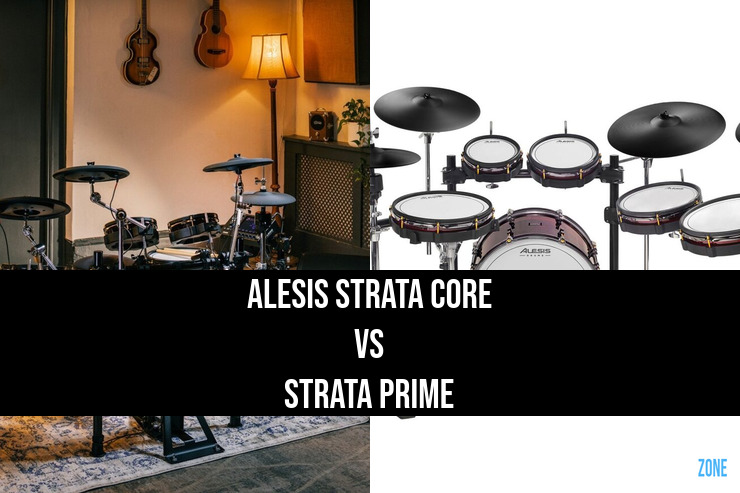
The Strata Core is our pick for a home player who wants the Strata sound-editing approach in a smaller arrangement. The Strata Prime suits an acoustic drummer who wants four toms, larger playing targets and separate analog outputs for recording or live mixing. Buy the Prime for those practical differences, not simply because its library is larger.
Alesis Strata Core vs Alesis Strata Prime (2026) Head to Head


The Alesis Strata Core is the easier kit to fit into a home practice space. The Strata Prime gives you a fourth tom, larger cymbals, a full-size kick shell and more audio outputs. Choose the Prime when you will use that bigger layout or need separate feeds for a mixer; choose the Core when three toms and a stereo drum mix cover your needs.
Both run BFD sounds inside the module and have adjustable mesh heads and stand-mounted magnetic hi-hats. The Prime upgrade changes the hardware and mixing options, rather than being a requirement for playing detailed sampled drums without a computer.
Key Differences
The Core has a 12-inch snare, two 8-inch toms and one 10-inch tom. The Prime moves to a 14-inch snare and four toms measuring 8, 10, 12 and 14 inches. That fourth tom gives fills another destination without buying an expansion. The larger snare and floor-tom targets may also suit your existing acoustic layout, though pad diameter alone does not establish better triggering.
The Core's 8-inch mesh kick tower is easier to position in a restricted room. The Prime has a 20-inch kick shell with a mesh head, so its front-to-back space and visual presence are closer to an acoustic bass drum. Both accept single or double kick pedals. A 20-inch shell and an 8-inch tower are different physical formats, not a reliable comparison of how accurately they detect pedal strokes.
The Core supplies a 12-inch hi-hat, two 12-inch crashes and a 14-inch ride. The Prime enlarges those to a 14-inch hi-hat, two 16-inch crashes and an 18-inch ride. Both have two crashes; the standard Prime does not include the extra cymbals or fifth tom found in an Expanded package.
The Core module has a 7-inch touchscreen and stereo quarter-inch main outputs. The Prime module has a 10.1-inch touchscreen, balanced XLR main outputs and four assignable quarter-inch outputs. Those assignable sockets let you send selected drum parts to separate mixer or audio-interface channels. The larger screen is useful for editing, but the output arrangement is the more substantial upgrade if you need control at the mixing desk.
The Alesis Strata Core is equipped with the Core, while the Strata Prime uses the Prime Drum Module.
Key Features in Common
Both kits use tension-adjustable mesh snare and tom heads with separate head and rim triggering. Their ARC crashes and rides respond around the full playing surface and have bow, edge and bell zones. The active magnetic hi-hat system works on a conventional hi-hat stand, with the module powering the controller. Neither kit supplies that stand.
The Core and Prime modules both run BFD sampled sounds, allow microphone mixing and sound layering, and import your own samples. You can play the onboard kits without a laptop. Both support USB MIDI and five-pin MIDI, plus Bluetooth audio for backing tracks. Bluetooth audio is an input for music; use wired headphones or a suitable monitor to hear the drum performance.
And here's a video of the Strata Prime.
For recording the onboard sounds into a DAW, use the modules' analog outputs and an audio interface. USB carries MIDI on both Strata modules, so a USB cable alone does not deliver their internal drum audio to the computer. MIDI can trigger a software instrument instead, but that records the software's sounds rather than the module's audio.
The Core is straightforward for a stereo recording. The Prime's four assignable outputs, alongside its main pair, offer more separation if your interface has enough inputs. Decide which parts you need to mix independently before choosing the module: individual-output routing is useful only when the rest of your recording setup can receive it.
Both standard kits include a rack and snare stand. Allow for a kick pedal, hi-hat stand, throne and monitoring. Leave room for your seated position and pedals as well as the rack. The Prime's fourth tom and larger kick shell need a different arrangement from the Core, even when you fold the rack inward.
The standard Prime leaves three trigger inputs available for expansion. The Core provides two additional quarter-inch trigger inputs. The Prime also has an SD-card slot for sample storage and import; the Core uses a USB flash drive. These are useful planning differences if you expect to add pads or manage a collection of personal samples.
Price Comparison Between The Alesis Strata Core and Strata Prime
Use the below to get up-to-date prices for both the Alesis Strata Core and Strata Prime
Hi-Hat
Cymbal Pads
Toms
Drum Module
Snare
Kick
Overview
Verdict
Choose the Core when you want a three-tom Strata kit for practice, rehearsal and stereo recording without devoting as much room to the kit. Choose the Prime when the four-tom layout, bigger cymbals and assignable audio outputs answer a specific need in your playing or production setup.
For a smaller Strata alternative, read Strata Club vs Strata Core. Our Roland TD316 vs Strata Core comparison covers a different midrange approach.

Matt Taylor