
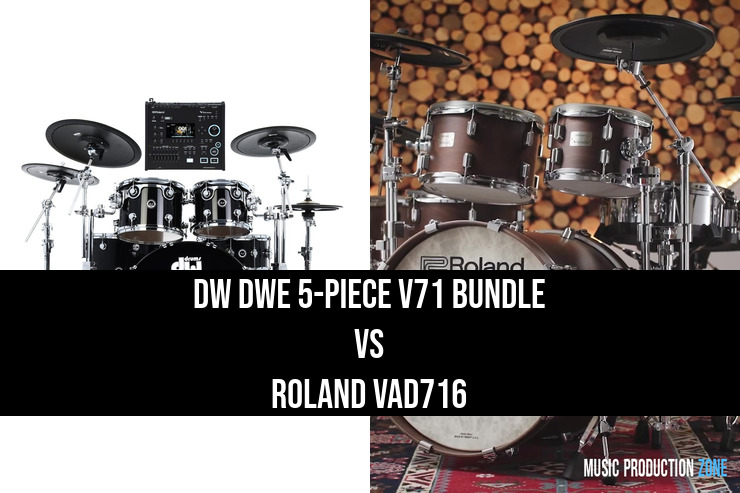
The VAD716 is our choice for a dedicated electronic setup built around Roland's digital pads. The DWe bundle earns its place when acoustic conversion and metal cymbals are features you will actually use. Its included pedal and stands also matter when comparing complete packages. The shared V71 means the decision is about the drums, triggering and hardware, rather than buying a different module sound library.
DW DWe 5-piece V71 bundle vs Roland VAD716 (2026) Head to Head


Choose the DW DWe five-piece V71 bundle if you want one set of shells for acoustic and electronic playing, wireless drum triggers and metal electronic cymbals. Choose the Roland VAD716 if you want a dedicated electronic kit with Roland's digital snare, hi-hat and ride and four toms.
Both use the Roland V71 sound module. The DWe bundle does not need a computer for its onboard drum sounds: its DrumLink hub sends the performance to the V71. This comparison covers the Piano Black Gloss five-piece bundle with DWe metal cymbals, hardware and V71, rather than a DWe shell pack or the separate Roland-cymbal bundle.
Key Differences
The DWe bundle has a 14-inch snare, 10- and 12-inch rack toms, a 16-inch floor tom and a 22-inch kick. Its maple shells can be converted for acoustic playing by removing the trigger assemblies and fitting the supplied acoustic heads. That is a physical changeover, not an instant module setting. You will need an appropriate acoustic cymbal setup for acoustic use too.
The VAD716 is a six-drum electronic configuration: a 14-inch PD-14DSX snare, 10- and 12-inch rack toms, two 14-inch floor toms and a 22-inch KD-22 kick. It gives you an extra tom, but its acoustic appearance does not make it a convertible acoustic drum set.
DWe sends trigger data wirelessly to its DrumLink hub. The hub then connects to a V71 digital trigger input over USB. Roland's standard VAD716 connects its snare, hi-hat and ride to three dedicated digital inputs and uses conventional trigger cables for the other pads. DWe reduces cabling around the drums; it still needs hub, module, power and audio connections.
The DWe cymbal pack has a 14-inch hi-hat, two 16-inch crash/rides and an 18-inch ride. Its metal surfaces have bell, bow and edge zones, with edge choking on the crash/rides. The VAD716 supplies the 14-inch VH-14D digital hi-hat, two 16-inch CY-16R-T crashes and the 18-inch CY-18DR digital ride. Choose by surface response and triggering, not diameter alone.
DWe's snare has positional and pressure sensing alongside its digiMAG throw-off. Roland's PD-14DSX has its own digital sensing, cross-stick handling, throw-off and tension control. DWe's software articulations are not a promise that every gesture behaves identically through the V71. Use the correct DWe trigger configuration for the sound source you plan to play.
Key Features in Common
Both kits have full-depth wooden tom and kick shells, mesh drumheads for electronic use and a stand-mounted hi-hat. Both offer two crash positions and an 18-inch ride. Neither requires a laptop to play the V71's onboard sounds.
The shared V71 supplies the same instrument editing, user-sample import, Bluetooth audio/MIDI and recording connections. It has balanced main outputs and eight balanced direct outputs. Either kit can send separate feeds to a live mixer without buying a different sound module.
For computer recording, both can send up to 32 audio channels through the V71 in vendor USB mode with Roland's driver. Generic mode carries stereo audio. The DWe bundle's Rubix24 interface is useful for an optional computer-based setup, but it is not required to unlock the V71's own USB recording channels.
Both the DW DWe 5-piece V71 bundle and Roland VAD716 are equipped with the same drum module (the V71), so your choice between the two e-drum kits will be based on your preferences between the pads and hardware on the separate kits.
With DWe, keep the wireless trigger batteries and pairing in your setup routine. Each trigger uses two AA batteries. Pair the pads with the hub, select the appropriate V71 trigger settings and test the hi-hat range and choking before a session. The wireless trigger link is separate from the V71's Bluetooth music and MIDI functions.
A DrumLink hub uses one V71 digital input when connected over USB. That leaves two digital ports for compatible Roland pads in a mixed setup. The standard VAD716 already occupies all three with its snare, hi-hat and ride. To combine those three digital pads with DWe triggers, Roland describes a MIDI connection from the hub instead; plan the connection and articulation mapping before buying additions.
The DWe bundle includes a DW 5000 kick pedal, hi-hat stand, snare stand, cymbal/tom stands and a module stand. It also includes the DrumLink hub, Rubix24, DW Soundworks licence and acoustic heads. You still need a throne and headphones or suitable monitoring. Its package is substantially more complete in supporting hardware than a standard VAD716.
The VAD716 includes its DTS-30S stand set and floor-tom legs, but needs a kick pedal, snare stand, hi-hat stand and throne. Do not confuse the tom/cymbal stands with those separately required items. An existing collection of hardware makes that difference less important; starting from an empty room makes it more important.
The two bass drums have 22-inch shells, but that is not the size of the sensor target. Roland specifies a 6.4-inch KD-22 striking surface; comparing that with a DWe shell diameter would be misleading.
Both need proper floor space. Roland's example VAD716 setup is about 1.95 by 1.5 metres including the hi-hat stand and throne. DWe's 22-inch kick, 16-inch floor tom and separate stands also need an acoustic-style layout. Wireless triggering clears cables without reducing the space taken by shell depth and stand feet.
Metal DWe cymbals still make an audible stick sound in the room. Roland's rubber-covered cymbals also make impact noise, and both kits transmit kick and pedal vibration through the floor. For shared-wall practice, consider the physical sound of the kit as well as the headphone mix.
Both V71 modules can use compatible expansion content and imported WAV samples on SD media. Check the licence terms for optional software and memberships separately. The permanent hardware choice here is between DWe's convertible wireless system and Roland's supplied digital-pad configuration.
Price Comparison Between The DW DWe 5-piece V71 bundle and Roland VAD716
Use the below to get up-to-date prices for both the DW DWe 5-piece V71 bundle and Roland VAD716
Hi-Hat
Cymbal Pads
Toms
Drum Module
Snare
Kick
Overview
Verdict
Buy the DWe V71 bundle when acoustic conversion, metal cymbals and the supplied DW hardware justify the system for you. Buy the VAD716 when you want four toms and a wired electronic kit centred on the PD-14DSX, VH-14D and CY-18DR. A shared module gives both strong recording options; it does not make their playing surfaces interchangeable.
For a smaller physical Roland setup with the same main digital pads, see Roland TD716 vs VAD716. For another metal-cymbal alternative, read Zildjian Alchem-E Gold EX vs Roland VAD516.

Matt Taylor