
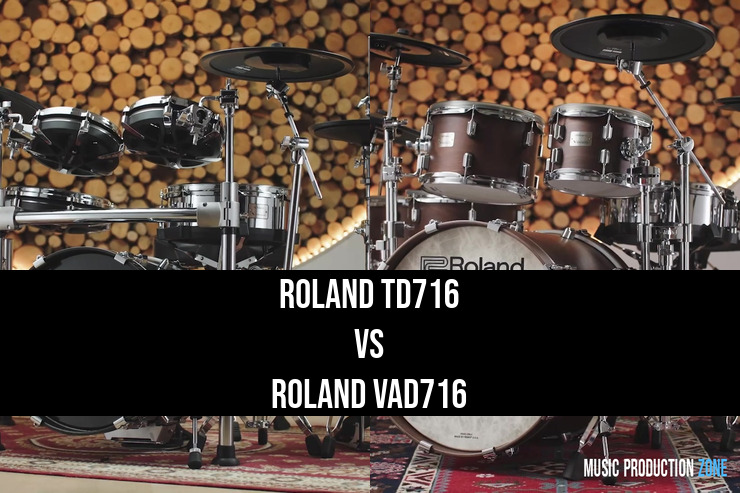
Choose the TD716 if you want the V71 module and flagship digital pads with a narrower rack-based layout. Choose the VAD716 if full-depth shells, larger floor toms and acoustic-style positioning are central to the kit you want. Their snare, hi-hat, ride and module are the same, so the VAD716 premium primarily buys a different physical drum setup.
Roland TD716 vs Roland VAD716 (2026) Head to Head


The Roland TD716 and VAD716 offer two different ways to build a kit around the V71 module. The TD716 keeps its toms on a rack, while the VAD716 puts electronic triggering into full-depth wood shells with separate stands and floor-tom legs.
Their shared module and main digital pads make this a layout decision as much as a specification comparison. A VAD716 does not bring a different sound engine simply because it looks more like an acoustic set.
Key Differences
The TD716 has two 10-inch PD-10X tom pads and two 12-inch PD-12X pads. The VAD716 uses a 10-inch PDA100 rack tom, a 12-inch PDA120 rack tom and two 14-inch PDA140F floor toms. Both have four toms, but the VAD716's larger floor toms and separate positioning change the distances you move around the kit.
The kick changes from the TD716's 18-inch KD-18-BK to the VAD716's 22-inch KD-22. Both use wood shells. These are shell dimensions, rather than measurements of the sensor's playing area, and neither kit produces an acoustic kick sound from its shell alone.
The TD716 includes the MDS-Stage 2 rack. The VAD716 comes with the DTS-30S stand set and floor-tom legs, giving you an acoustic-style arrangement. That may suit a stage or dedicated drum room, but it creates more individual hardware pieces to position and pack.
Roland's example playing space is 1.65 by 1.5 metres for the TD716 and 1.95 by 1.5 metres for the VAD716. Measure your room with the throne and hi-hat position included; turning the toms closer together does not remove the shell and stand space.
Key Features in Common
Both kits have the PD-14DSX digital snare, including its throw-off and tension control, the VH-14D digital hi-hat and the CY-18DR digital ride. Both also include two 16-inch CY-16R-T crash pads. You are not giving up those main playing surfaces by choosing the rack kit.
The shared V71 provides sample import, Bluetooth audio, balanced main outputs and eight balanced direct outputs. Both kits can record up to 32 audio channels over USB in vendor mode with Roland's driver; generic mode carries stereo audio. The connections and recording options are therefore equivalent.
Both the Roland TD716 and Roland VAD716 are equipped with the same drum module (the V71), so your choice between the two electronic drum sets will be based on your preferences between the cymbals/hardware/pads on the separate kits.
The linked VAD716 configuration is Gloss Ebony. Other finishes do not automatically mean a different module or pad set, but check the exact shell pack and hardware listed before ordering.
Neither standard kit includes a kick pedal, snare stand, hi-hat stand or throne. The VAD716's stand set does not cover every item needed to sit down and play. Both kits also use the V71's three digital inputs for the supplied snare, hi-hat and ride, so further pads need a suitable remaining analog input.
Price Comparison Between The Roland TD716 and Roland VAD716
Use the below to get up-to-date prices for both the Roland TD716 and Roland VAD716
Hi-Hat
Cymbal Pads
Toms
Drum Module
Snare
Kick
Verdict
For players who mainly care about the V71 sounds, digital snare control and recording connections, the TD716 already supplies those essentials. The VAD716 is the more relevant choice when you want the shell sizes, floor-tom arrangement and appearance of an acoustic kit.
If you are still deciding how far to move up Roland's rack range, see our Roland TD516 vs Roland TD716 comparison.

Matt Taylor