
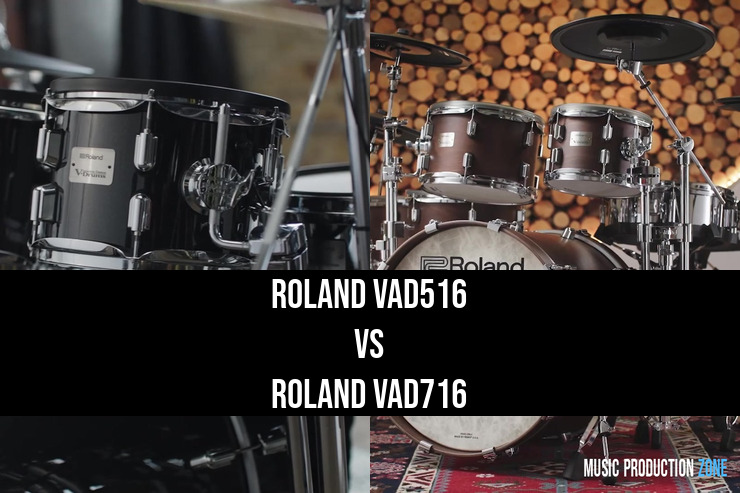
The VAD516 is our pick for a player who wants a three-tom acoustic-style kit and mainly records over USB. The VAD716 makes more sense for a four-tom setup or a stage rig that needs several separate analog drum feeds. Its extra floor tom and V71 outputs are the clearest reasons to step up; the core digital playing surfaces are shared.
Roland VAD516 vs Roland VAD716 (2026) Head to Head


Choose the Roland VAD516 if you want full-depth wood shells and Roland's PD-14DSX digital snare in a five-piece kit. Choose the VAD716 if you want a second floor tom, a 22-inch bass drum and the V71's larger set of analog outputs.
Both already include the same digital snare, hi-hat and ride. The VAD716 is therefore an upgrade in kit layout and module connections, rather than a way to obtain digital pads that the VAD516 lacks.
Key Differences
VAD516 has 10-inch PDA100-MS and 12-inch PDA120-MS rack toms, plus one 14-inch PDA140F-MS floor tom. VAD716 has a 10-inch PDA100, a 12-inch PDA120 and two 14-inch PDA140F floor toms. The fourth tom extends the physical kit for fills and additional voices. It also adds another shell and floor-tom legs to your transport load.
VAD516's KD-20-MS has a 20-inch wood shell; VAD716's KD-22 has a 22-inch shell. Both are electronic kick drums suitable for single or double pedals. The shell sizes describe their acoustic-style format, not a directly comparable measurement of the beater's trigger area.
Both kits include a 16-inch CY-16R-T crash. The other crash is a 14-inch CY-14R-T on VAD516 and another 16-inch CY-16R-T on VAD716. These are analog cymbal pads with bow/edge triggering and choke support, separate from the shared digital ride.
The V51 in VAD516 has stereo main outputs and two direct outputs. The V71 in VAD716 provides balanced stereo main outputs on XLR and quarter-inch sockets, plus eight balanced direct outputs. For a live engineer who wants kick, snare and other drum groups on separate mixer channels, the V71 offers more routing room.
VAD516 comes in Midnight Sparkle wrap. The VAD716 offer linked here is Gloss Ebony; the family also has other finishes. VAD516's standard hardware includes two DCS-30 combination stands, a DBS-30 boom stand and PDS-5 module stand, with regional variations. VAD716 uses the DTS-30S stand set.
The Roland VAD516 is equipped with the V51, while the Roland VAD716 uses the V71.
Key Features in Common
The 14-inch PD-14DSX snare, 14-inch VH-14D hi-hat and 18-inch CY-18DR ride are the same on both kits. That includes the snare throw-off and tension controls, detailed hi-hat pedal response and digital ride articulation. Buy the VAD716 for its additional hardware and connections, rather than expecting a different snare pad.
Both have full-depth wood tom shells, adjustable mesh heads and an acoustic-style arrangement on individual stands and floor-tom legs. Neither needs a computer to produce its onboard drum sounds. The V51 and V71 share Roland's current sound-engine family, sample import and expansion options.
Both modules support 32-channel audio recording over USB in vendor mode with the appropriate Roland driver. Generic mode is stereo. If your DAW receives the drums over USB, VAD716's extra analog outputs do not increase that USB channel count. They are most useful for a mixer or analog recording interface.
V71 has eight front-panel faders, while V51 has six. On V71, crash, ride and AUX have separate fader groups; V51 uses a combined cymbal group. Both also provide five-pin MIDI, computer editing and Bluetooth backing-track audio. Wired headphones or monitors remain the practical way to hear your live playing.
The digital pad trio uses all three digital inputs on either module. VAD516's second crash occupies CRASH 2, leaving its other three additional analog sockets available. VAD716's standard four-tom configuration leaves the four AUX inputs free. Expansion still depends on the chosen pad's connection requirements.
Roland's example setups are about 1.9 by 1.5 metres for VAD516 and 1.95 by 1.5 metres for VAD716, including the throne and supporting hardware. That small width difference does not describe the extra shell you will pack and carry. Neither standard kit includes a kick pedal, snare stand, hi-hat stand or throne. Add monitoring and an SD card if you need card-based storage.
Price Comparison Between The Roland VAD516 and Roland VAD716
Use the below to get up-to-date prices for both the Roland VAD516 and Roland VAD716
Hi-Hat
Cymbal Pads
Toms
Drum Module
Snare
Kick
Verdict
VAD516 covers the digital pad experience and multitrack USB recording in a three-tom wood-shell kit. VAD716 is the stronger fit when a second floor tom and the V71's balanced output routing are part of your setup. Both can serve a serious playing rig; the useful upgrade depends on how you arrange and connect it.
For V51 hardware in a rack, see VAD516 vs TD516. For the V71 rack alternative, read TD716 vs VAD716.

Matt Taylor