
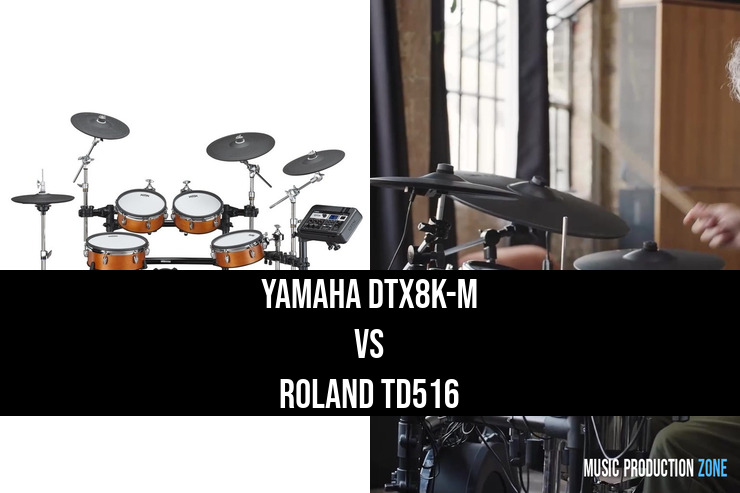
We would choose the TD516 for recording individual drum tracks and for its supplied digital snare, hi-hat and ride. Choose the DTX8K-M if you want Yamaha's mesh wood-shell pads and are happy recording a stereo drum mix. The included stands make Yamaha's package more complete, but the decision should still turn on the playing surfaces and recording workflow you will use.
Yamaha DTX8K-M vs Roland TD516 (2026) Head to Head


The Roland TD516 is the better fit if you want its digital snare, hi-hat and ride, or need separate drum audio tracks over USB. The Yamaha DTX8K-M suits a player who prefers wood-shell mesh pads, direct Kit Modifier controls and a package that includes both hi-hat and snare stands.
This comparison covers the DTX8K-M with the DTX-PRO module, not a PROX bundle. Both kits have three toms, two crashes and a stand-mounted hi-hat. Their main differences are how the pads sense your playing and how the modules handle recording and expansion.
Key Differences
The TD516 supplies a 14-inch PD-140DS digital snare, 14-inch VH-14D digital hi-hat and 18-inch CY-18DR digital ride. These connect to dedicated digital inputs on the V51 and use detailed sensing of touch and playing position. This is a matched module-and-pad system; the USB connectors are not ordinary computer accessory sockets for arbitrary pads.
Yamaha supplies a 12-inch XP125SD-M mesh snare, 13-inch RHH135 hi-hat and 15-inch PCY155 ride. The snare has a wood shell and sits on the included SS662 stand. Its conventional trigger connection and cross-stick handling differ from Roland's digital snare. The Yamaha ride has bow, edge and bell zones, so choosing Yamaha does not mean losing a separate ride bell.
The DTX8K-M has three 10-inch XP105T-M dual-zone mesh toms. The TD516 has two 10-inch PD-10P toms and a 12-inch PD-12P tom. Roland gives the floor-tom position a larger head, while Yamaha keeps the tom diameters equal. Both layouts leave room to assign different head and rim sounds.
Yamaha supplies two 13-inch PCY135 crashes. Roland supplies a 12-inch CY-12C-T and a 14-inch CY-14R-T in the crash positions. Both kits support choking, but the supplied cymbals, zone arrangements and strike areas differ. Do not read the CY-14R-T model name as meaning the TD516 includes a second dedicated ride in addition to the CY-18DR.
The V51 sends up to 32 channels of USB audio to a computer in vendor mode, with the appropriate Roland driver and setup. The DTX-PRO sends a stereo mix. Roland therefore allows individual drum and ambience tracks to be balanced after the performance without changing to a software drum instrument.
The V51 also has two direct analog outputs in addition to its main pair. The DTX-PRO has main left and right outputs. Those extra Roland connections are useful when a mixer needs separate feeds, but they are not the same thing as one physical output for every drum.
The Yamaha DTX8K-M is equipped with the DTX-PRO, while the Roland TD516 uses the V51.
Key Features in Common
Both kits have adjustable mesh snare and tom heads, a separate kick tower, a moving hi-hat and two crashes. Both can be played through wired headphones without a computer. Each module offers practice tools, kit editing, audio recording and user sample import.
Both support USB MIDI, so either can trigger a computer drum instrument. That route lets the software provide the sounds; it is a different use from recording the module's own audio. Both also have a wired input for a music player.
Both have modules capable of much more editing than selecting a preset. Yamaha's Kit Modifier knobs provide immediate control over ambience, compression and effects. Roland's V51 offers detailed instrument and mix editing alongside its DW-based sound library.
The V51 receives Bluetooth audio for playing along with music. DTX-PRO has no built-in Bluetooth. Use wired headphones on either kit for live drum monitoring: Bluetooth music input is not a wireless headphone output.
Yamaha imports WAV samples from USB storage; Roland imports user samples from SD media. Roland also supports its compatible expansion content through Roland Cloud. Check the content's licence and membership requirements before treating a supplied software or membership offer as a permanent library entitlement.
The DTX8K-M includes an HS650A hi-hat stand and SS662 snare stand, as well as its RS8 rack. The standard TD516 includes the MDS-Standard 3 rack but needs separate hi-hat and snare stands. Both need a kick pedal, throne and headphones or a suitable monitor. Compare complete playable packages when assessing the step up to Roland.
Yamaha's KP90 has a 7.5-inch playing surface with a multilayer cushion. Roland's KD-12 has a 12-inch housing around a 7.5-inch striking area. Both support double pedals; comparing the housing diameter with Yamaha's beater target would exaggerate the difference.
The V51's three digital inputs are occupied by the supplied snare, hi-hat and ride. Its additional analog inputs provide a different expansion path. Yamaha's available expansion depends on the existing trigger connections, pad type and cabling. Check the intended extra pad against the module before buying it.
Yamaha lists an average DTX8 footprint of 1,100 by 1,500 mm. Your seat, stand-leg positions and playing clearance still matter. Both kits use a rack plus separate floor hardware, so measure the actual corner or riser rather than assuming the smaller snare guarantees a smaller complete setup.
On an older DTX-PRO, check the installed firmware before comparing factory sounds and sample capacity with current specifications. Updating the module does not add Roland-style digital trigger ports or multichannel USB audio.
Price Comparison Between The Yamaha DTX8K-M and Roland TD516
Use the below to get up-to-date prices for both the Yamaha DTX8K-M and Roland TD516
Hi-Hat
Cymbal Pads
Toms
Drum Module
Snare
Kick
Verdict
Buy the TD516 if its digital playing surfaces and multitrack recording solve a specific need. Buy the DTX8K-M if the Yamaha wood-shell mesh setup and included stands suit you, and a stereo recording workflow is enough. Both offer useful editing and practice features; pad response, hardware and routing are more useful deciding factors than a raw sound count.
For a less expensive Roland configuration, read Roland TD316 vs Roland TD516. For Yamaha's smaller rack-mounted mesh setup, see Yamaha DTX6K5-M vs Roland TD316.

Matt Taylor