
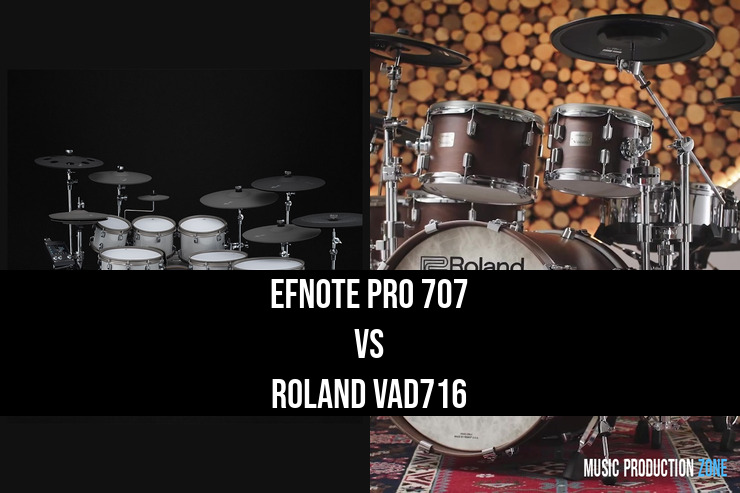
Choose the Pro 707 if you will use its extra tom, effects cymbals and twelve XLR output buses. Choose the VAD716 if the PD-14DSX snare, Roland digital hi-hat and ride, and V71 sound-editing workflow matter more than having the largest layout. For recording, both can send separate audio tracks directly to a computer; Roland offers more USB channels, while EFNOTE makes a twelve-bus stage feed straightforward.
EFNOTE Pro 707 vs Roland VAD716 (2026) Head to Head


The EFNOTE Pro 707 and Roland VAD716 put electronic drums into full-size wooden shells, but they suit different priorities. The Pro 707 surrounds you with five toms and eight cymbal positions, using a separate floor unit for its trigger connections and stage outputs. The VAD716 has four toms, Roland's digital snare, hi-hat and ride, and the V71 module.
For a stage installation, the EFNOTE's routing and larger layout are persuasive. For a drummer who wants Roland's digital playing surfaces and a module that supports extensive sound expansion, the VAD716 is the stronger fit. Neither is a compact apartment kit.
Key Differences
The Pro 707 has 8-, 10- and 11-inch rack toms plus 13- and 15-inch floor toms. The VAD716 has 10- and 12-inch rack toms and two 14-inch floor toms. EFNOTE gives you five distinct tom sizes for descending fills. Roland gives you fewer toms, with larger rack-tom targets and a matched pair of floor-tom sizes.
EFNOTE supplies a 20-inch ride, three crashes measuring 16, 18 and 18 inches, a 17-inch effects cymbal, an 8-inch splash and an 18-inch china, plus its 14-inch hi-hat. Roland supplies an 18-inch CY-18DR ride, two 16-inch CY-16R-T crashes and a 14-inch VH-14D hi-hat. The Pro 707 provides separate places for more cymbal voices, useful when an arrangement calls for quick changes between ride, crash, splash and china.
Both snares are 14 inches, but they use different sensing systems. The EFNOTE EFD-S1455 has head, rim and side articulations. Roland's PD-14DSX is a USB digital snare with multi-sensor detection, a physical strainer lever and snare tension control. The VAD716 also uses USB digital connections for its hi-hat and ride. EFNOTE's hi-hat measures pedal movement optically through its own dedicated connection. These are separate systems: EFNOTE's optical hi-hat is not a Roland digital pad.
The Pro 707 uses a 20-inch EFD-K2015 kick shell, while the VAD716 has a 22-inch KD-22. Shell diameter describes the drum's size and appearance, rather than the diameter of the beater's trigger target. Both need a separate kick pedal.
The EFD-PRO separates a small touchscreen control surface from a floor-standing base unit. Its twelve balanced XLR buses can send groups such as kick, snare, toms and cymbals to a mixing desk. The V71 keeps its controls and connections in one module, with a stereo main output and eight direct output channels. Its XLR and quarter-inch main connectors carry the same main pair; they do not create extra independent buses.
The EFNOTE Pro 707 is equipped with the EFD-PRO, while the Roland VAD716 uses the V71.
Key Features in Common
Both kits provide mesh drum heads, stand-mounted moving hi-hats, multi-zone cymbals and choke control. Both make their own drum sounds without a computer. Either can serve as a practice kit through wired headphones or feed a PA for performance.
Both modules offer Bluetooth audio for backing tracks, Bluetooth MIDI, USB MIDI, an internal performance recorder and multichannel USB audio. Bluetooth audio is an input for music playback, so use wired headphones for monitoring your playing.
Both let you edit drum sounds and save personal kits. EFNOTE provides tuning, muffling, layering and bus processing. Roland provides instrument editing, layered sounds and effects. The useful question is whether you prefer their sounds and controls, rather than which product advertises the larger library.
The V71 sends and receives up to 32 USB audio channels with the Roland driver in vendor mode. Generic mode provides stereo USB audio. The EFD-PRO sends twelve audio channels to a computer and receives a stereo return. Those twelve channels follow its bus routing: they are not fifteen isolated tracks for every connected pad. Plan bus assignments before recording a song that may need detailed mixing later.
For a live desk, EFNOTE's balanced monitor inputs can bring a return mix back to the drummer, while its bus controls set what leaves for the house engineer. Keep the monitor mix and outgoing drum mix distinct when setting levels. Roland's eight direct outputs also allow separate feeds, but require quarter-inch connections or suitable adapters at the stage box.
On EFNOTE firmware version 2, User Tones and Instrument Expansions are managed through EFNOTE Desktop Tools. These additions apply to kick, snare and tom sounds, not every cymbal position. The V71 can import WAV samples from an SD card and use compatible Roland Cloud expansions. Check firmware and the requirements of any optional sound content before planning a show around it.
The Pro 707 occupies all fifteen of the EFD-PRO's pad inputs. The VAD716 has four AUX trigger inputs for compatible additions, although its three digital inputs are already used by the supplied snare, hi-hat and ride. A bigger starting kit and more room to expand are different advantages.
Allow space for stands, cables and walking around either kit. Roland quotes a configured footprint of about 195 by 150 cm, including the seating area. The Pro 707's five toms and effects cymbals require careful placement; draw out the intended layout before choosing it for a fixed riser. Neither wooden shells nor headphones remove stick noise or pedal vibration.
Compare the actual stand pack in the offer. EFNOTE stand packages vary, and a complete configuration still needs a kick pedal, hi-hat stand, throne and monitoring. The standard VAD716 includes its DTS-30S hardware set, but requires a kick pedal, snare stand, hi-hat stand and throne. Photographs can show accessories that are not supplied.
Price Comparison Between The EFNOTE Pro 707 and Roland VAD716
Use the below to get up-to-date prices for both the EFNOTE Pro 707 and Roland VAD716
Hi-Hat
Cymbal Pads
Toms
Drum Module
Snare
Kick
Verdict
The Pro 707 makes sense when you have space for a large kit and a practical use for its many playing positions and twelve XLR buses. The VAD716 is the better choice when Roland's digital pads, V71 editing and recording connections are your priorities.
If you want EFNOTE's stage-routing system with fewer drums around you, see Pro 703X vs Pro 707. For the V71 in a rack-based kit, compare TD716 vs VAD716.

Matt Taylor