
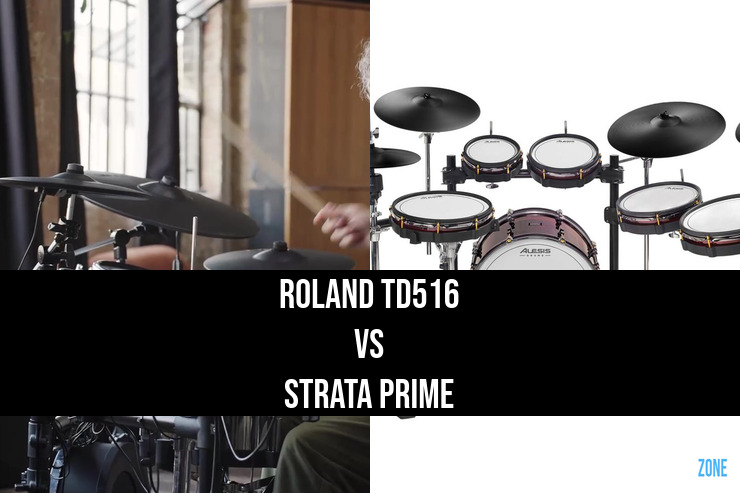
Choose the TD516 for its digital-pad system and direct multichannel recording from the V51 into a DAW. Choose the Strata Prime for its extra tom, larger crashes, touchscreen editing and four assignable analog outputs. The Prime needs an audio interface to record its onboard sounds into a computer; the TD516 needs the appropriate Roland driver and USB mode for separate audio channels.
Roland TD516 vs Alesis Strata Prime (2026) Head to Head


The Roland TD516 is the stronger starting point if you want Roland's digital snare, hi-hat and ride together with multichannel USB recording. The Alesis Strata Prime suits players who want a four-tom layout, a full-size kick shell and a large touchscreen for shaping BFD drum sounds.
Both are substantial kits with 14-inch snares and 18-inch rides. The choice is less about those headline sizes and more about the sensors, module workflow and space each arrangement needs.
Key Differences
The TD516 includes the 14-inch PD-140DS digital snare, 14-inch VH-14D digital hi-hat and 18-inch CY-18DR digital ride. Their digital connections support detailed detection, including snare position and touch sensing on the snare and ride. The VH-14D also supports touch muting. All three occupy the V51's three digital trigger inputs.
The Strata Prime uses analog trigger connections for its 14-inch mesh snare, 14-inch Active Magnetic hi-hat and 18-inch ARC ride. The hi-hat controller senses pedal position magnetically, while the ARC ride provides bow, edge and bell zones around its playing surface. These are different sensing systems. Having an equally large snare or ride does not make the pads interchangeable with Roland's digital models.
The TD516 has two 10-inch PD-10P toms and one 12-inch PD-12P. The Prime has four toms: 8, 10, 12 and 14 inches. The Alesis arrangement gives you another tom voice and a larger final target. The Roland toms use three piezo sensors per pad, so tom count and diameter should be considered separately from the triggering design.
Roland supplies a KD-12 kick tower with a 7.5-inch playing surface. Alesis supplies a 20-inch mesh kick shell. The KD-12's housing size is not its striking area, and neither measurement should be compared directly with the Prime's shell diameter as a triggering score. The Prime requires room for the shell; the tower is a more compact physical arrangement.
The Prime's two 16-inch crashes are larger than the TD516's 12-inch CY-12C-T and 14-inch CY-14R-T. Alesis gives its crashes bell, bow and edge zones; the Roland crash setup uses bow and edge triggering. Both kits include two crashes in their standard configurations.
The Roland TD516 is equipped with the V51, while the Strata Prime uses the Prime Drum Module.
Key Features in Common
Both kits have mesh snare and tom heads that you can tension to suit your preferred rebound. Both provide head and rim sounds, stand-mounted hi-hats, three-zone rides and chokeable crash cymbals. A conventional hi-hat stand is required for either kit, and it is sold separately.
The V51 and Prime modules both work without a computer for their onboard sounds. They allow sound editing, sample import, Bluetooth backing-track audio, USB MIDI and five-pin MIDI. Bluetooth backing tracks do not provide a wireless headphone-monitoring connection. Use wired monitoring when playing, and treat any bundled computer software as a separate sound source.
And here's a video of the Strata Prime.
For a DAW-based studio, the V51 provides multichannel USB audio in vendor mode with Roland's dedicated driver. Generic USB mode gives stereo audio. Set the module and driver correctly before creating separate drum tracks. The TD516 can therefore record the module's drum audio without a separate analog audio interface.
The Prime module's USB connection carries MIDI. To capture its onboard BFD sounds, connect its analog outputs to an audio interface. Its balanced XLR main pair and four assignable quarter-inch outputs are useful for sending groups or selected instruments to a live mixer. The V51 has a stereo main pair and two direct outputs, so Prime offers more separate physical output feeds even though Roland has the more direct multichannel USB workflow.
Editing also feels different in use: the Prime has a 10.1-inch touchscreen, while the V51 uses its display, buttons and knobs, with computer editing available. If you often build sounds at the kit, consider which controls you want within reach. Neither the size of the screen nor the number of sounds settles which drum library you will prefer.
The standard Prime includes its snare stand; the standard TD516 requires one separately. Both need a kick pedal, hi-hat stand and throne. Measure the playing area around your pedals and seated position. The Prime's fourth tom and kick shell make it a less convenient fit for a room where the kit must share space with desks or other instruments.
These are the standard TD516 and Strata Prime configurations. The TD516 does not include the PD-14DSX snare, and the Prime does not include the fifth tom or additional cymbals of the Expanded package. Plan upgrades around the actual module inputs and compatible pad models.
Price Comparison Between The Roland TD516 and Strata Prime
Use the below to get up-to-date prices for both the Roland TD516 and Strata Prime
Hi-Hat
Cymbal Pads
Toms
Drum Module
Snare
Kick
Overview
Verdict
The TD516 earns its place for players who specifically want the digital snare, hi-hat and ride, or who record individual module audio channels straight into a computer. The Strata Prime is the better fit when four toms, a full-size kick and a touchscreen editing environment matter more, especially if you already have a suitable audio interface or live mixer.
See Strata Core vs Strata Prime for the smaller Alesis option. Our Roland TD516 vs TD716 comparison explains the next step in Roland's rack-kit range.

Matt Taylor