
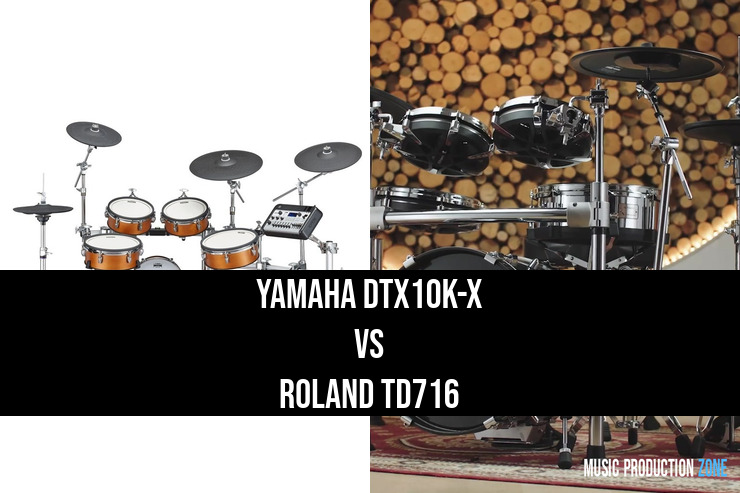
We would choose the TD716 for multitrack USB recording and Roland's digital playing surfaces. Choose the DTX10K-X if the TCS snare and tom response is what you want, and stereo USB audio or separate analog recording feeds cover your needs. Yamaha includes the snare and hi-hat stands; Roland's standard package needs those added.
Yamaha DTX10K-X vs Roland TD716 (2026) Head to Head


The Yamaha DTX10K-X suits a drummer who wants TCS silicone heads, wood-shell pads and Yamaha's DTX-PROX controls. The Roland TD716 is the stronger choice for its matched digital snare, hi-hat and ride, a fourth tom and separate drum audio tracks over USB.
These are different approaches to a flagship rack kit. Yamaha combines its 12-inch TCS snare and three TCS toms with a separate mesh kick pad. Roland uses mesh drum heads and an 18-inch kick shell, with digital connections for three of its main playing surfaces. The Yamaha compared here is the TCS-head DTX10K-X, not the mesh-head DTX10K-M.
Key Differences
Yamaha's XP125SD-X snare has a 12-inch TCS head and head/rim sensing. The TD716 supplies the 14-inch PD-14DSX digital snare, with position sensing, cross-stick detection, a throw-off and a snare-tension control. Roland's larger head and extra sensing make this more than a comparison of pad diameters. Try the TCS and mesh surfaces if you can: head material is a physical preference that a sound-library total cannot settle.
The DTX10K-X has two 10-inch XP105T-X toms and a 12-inch XP125T-X. The TD716 has two 10-inch PD-10X pads and two 12-inch PD-12X pads. Roland adds a fourth tom position, while Yamaha gives all three toms wood shells and TCS heads. Both provide head and rim sounds.
The Yamaha RHH135 is a 13-inch stand-mounted hi-hat. Roland's 14-inch VH-14D is a digital two-piece hi-hat with detailed open/closed and touch sensing. Both use a real hi-hat stand, but their controllers and module connections differ. The VH-14D is not a direct pad replacement for the DTX-PROX.
Yamaha includes 13-inch PCY135 and 15-inch PCY155 crashes, plus a 17-inch PCY175 ride with position sensing. Roland supplies two 16-inch CY-16R-T crashes and an 18-inch CY-18DR digital ride. Yamaha's three-zone cymbals already provide bow, edge and bell articulations; Roland's digital ride adds its own sensing system rather than simply adding a bell sound.
For recording the module's sounds, the V71 sends up to 32 audio channels to a computer in vendor mode with the appropriate Roland driver. The DTX-PROX sends stereo USB audio. Choose Roland if you want to rebalance individual drum and ambience tracks after recording without routing a collection of analog cables.
The Yamaha DTX10K-X is equipped with the DTX-PROX, while the Roland TD716 uses the V71.
Key Features in Common
Both kits work through wired headphones without a computer. Both have a separate kick drum pad, moving hi-hat, two crashes and a ride, with a rack holding the toms. Both modules support kit editing, practice tools, audio recording and WAV sample import.
Each module also has a stereo main output and eight additional analog output channels. You can send separate drum feeds to a mixer or audio interface from either kit. Yamaha places its eight individual channels on four stereo TRS sockets, so splitting those feeds calls for suitable breakout cables. Roland has eight separate balanced direct-output sockets and balanced main outputs, with both XLR and quarter-inch main connectors.
Both support USB MIDI and five-pin MIDI connections. MIDI sends the performance to a software instrument; it does not record the module's audio. Either kit can be used that way if you prefer computer-based drum sounds.
The DTX-PROX puts ambience, compression and effects on dedicated Kit Modifier knobs and uses rotary faders for hands-on adjustment. Its current firmware expands the preset library to 100 kits, with another 200 user slots. Check an older module's installed firmware before expecting the expanded library. Updating sounds does not turn its stereo USB connection into a multichannel audio interface.
The V71 has a colour screen, faders, detailed instrument editing and compatible Roland Cloud expansion content. Its 200 kit locations include the factory presets; they are not 200 additional user slots. Yamaha's 300 total locations do not establish a better sound engine. Listen to the sounds and consider how much editing you want to do.
The DTX-PROX can receive Bluetooth music where that feature is supported in the sales region. The V71 supports Bluetooth audio and MIDI. Neither feature replaces wired headphones for monitoring your drum hits. Yamaha imports samples from USB storage; Roland uses SD media. Both can record a stereo performance internally or to their supported storage.
Yamaha's 12-inch KP128 has a mesh head backed by a cushion. Roland's KD-18-BK uses an 18-inch wood shell. That shell diameter is not a like-for-like measurement of the beater target. Both support double pedals, but you still need to choose and supply the pedal.
The DTX10K-X includes the RS10-HXR rack, HS740A hi-hat stand and SS662 snare stand. Roland supplies the MDS-Stage 2 rack with the TD716; the hi-hat and snare stands are additional purchases. A throne and monitoring are required with either kit. Those additions belong in your package comparison before deciding whether either kit is within reach.
Roland's example setup measures about 1.65 by 1.5 metres including the hi-hat stand and throne. Allow room for Yamaha's separate stands and kick pad too; a rack does not contain the entire playing area. Measure stand legs, seat position and pedal clearance in your room. Headphones reduce the amplified sound, while stick impacts and floor vibration remain.
The TD716 uses all three V71 digital inputs for its supplied snare, hi-hat and ride. Its four auxiliary trigger jacks provide an analog expansion route. Yamaha's expansion depends on pad compatibility and the way its trigger inputs are cabled. Check the intended extra pad rather than assuming every spare connection supports every articulation.
Price Comparison Between The Yamaha DTX10K-X and Roland TD716
Use the below to get up-to-date prices for both the Yamaha DTX10K-X and Roland TD716
Hi-Hat
Cymbal Pads
Toms
Drum Module
Snare
Kick
Verdict
Buy the DTX10K-X for its TCS wood-shell pads, direct Yamaha controls and included stands. Buy the TD716 for its digital snare, hi-hat and ride, fourth tom and multichannel USB recording. Both can supply separate analog feeds, so that feature alone does not decide between them.
For a mesh-head Yamaha at the next level down, read Yamaha DTX8K-M vs Roland TD516. For the difference between Roland's V51 and V71 rack kits, see Roland TD516 vs TD716.

Matt Taylor