
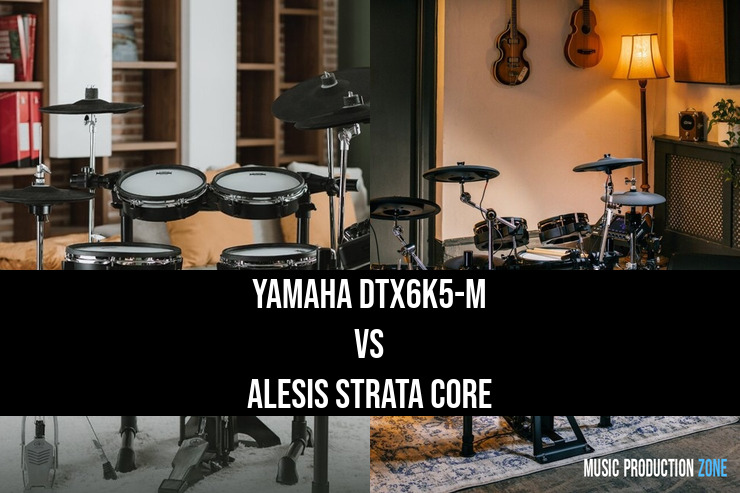
Choose the DTX6K5-M for three 10-inch toms, a supplied hi-hat stand and direct stereo USB audio. Choose the Strata Core for its 7-inch touchscreen, BFD editing and 360-degree ARC cymbal response. Core's USB connection carries MIDI; recording its onboard audio into a computer requires its analog outputs and an audio interface.
Yamaha DTX6K5-M vs Alesis Strata Core (2026) Head to Head


The Yamaha DTX6K5-M is the simpler fit for a drummer who wants larger rack toms, physical sound-shaping knobs and stereo USB recording. The Alesis Strata Core is the stronger option if you want to build and mix BFD drum sounds on a touchscreen, with mesh heads on the kick as well as the snare and toms.
These are both three-tom, two-crash kits with stand-mounted hi-hats. Choosing between them means deciding which playing layout and recording workflow you want, rather than counting sounds in two very different libraries.
Key Differences
The Yamaha has a 12-inch XP120L-M snare and three 10-inch XP100L-M toms. The Strata Core also has a 12-inch snare, but its toms measure 8, 8 and 10 inches. Both use adjustable mesh heads with head and rim triggering. Yamaha provides the larger pair of rack-tom targets, which may suit a drummer moving from an acoustic kit; that does not establish a universal winner for triggering or rebound.
Kick construction differs more substantially. Yamaha's KP90 uses a 7.5-inch rubber playing surface over a multilayer cushion. The Core has an 8-inch mesh kick tower. Both accept single or double pedals. With Core you can adjust the kick head's tension, while the KP90 gives you a fixed cushioned surface. Your preferred beater spacing and pedal position still need checking when you assemble either kit.
Yamaha supplies a 13-inch RHH135 hi-hat, two 13-inch PCY135 crashes and a 15-inch PCY155 ride. Core uses a 12-inch Active Magnetic hi-hat, two 12-inch ARC crashes and a 14-inch ARC ride. Both sets of crashes and rides have bell, bow and edge zones. The Alesis ARC cymbals respond around the full playing surface; Yamaha's assembly instructions specify orienting its cymbals with the Yamaha logo facing the player. This matters if your cymbals tend to rotate while you play.
Both hi-hats need a conventional stand. Yamaha includes the HS650A, whereas Core's stand is a separate purchase. Alesis uses a powered magnetic controller to detect pedal position. Yamaha's RHH135 uses its own controller arrangement; these are different trigger systems, so do not assume the hats can be swapped between modules without checking compatibility.
The DTX-PRO's Kit Modifier knobs adjust ambience, compression and effects. Core's 7-inch touchscreen puts BFD instruments, microphone balances, layering and processing into a graphical editing workflow. Yamaha is convenient for changing a few broad sound settings quickly. Alesis gives you a more visual way to assemble and mix a kit at the module.
The Yamaha DTX6K5-M is equipped with the DTX-PRO, while the Alesis Strata Core uses the Core.
Key Features in Common
Neither kit needs a laptop to play its onboard drum sounds. Both include a rack, three dual-zone mesh toms, a dual-zone mesh snare, a kick tower, two chokeable crashes and a three-zone ride. Both support sample import, sound editing, a metronome and recording functions.
Their main analog outputs are a stereo pair, with headphone monitoring available. Both have USB MIDI and five-pin MIDI connections, but the Yamaha has MIDI OUT only while Core has MIDI IN and OUT. Neither module has a bank of assignable analog direct outputs for a multichannel live mix.
For a home studio, the DTX-PRO's stereo USB audio is a useful advantage. It can send the sound of the onboard kit to your recording software without an external interface. Use the Yamaha Steinberg USB driver where required by your computer. A stereo recording combines the drums into one mix, so adjust the module's balance before recording if you need a louder snare or quieter cymbals.
Core sends MIDI over USB. That can trigger a drum instrument on the computer, but it does not record the internal BFD sounds. To capture those sounds, connect Core's stereo outputs to an audio interface. Owning a suitable interface already makes this a smaller practical obstacle; buying one solely for the kit changes the equipment you need.
Core receives Bluetooth audio for playing along with music. The DTX-PRO has no built-in Bluetooth, so use its wired AUX input for backing tracks. Keep your drum monitoring wired on either setup. Bluetooth input does not mean you can use Bluetooth headphones to monitor the performance.
Core includes a snare stand, while Yamaha mounts the snare on a rack arm. Yamaha includes the hi-hat stand that Core leaves out. Both still require a kick pedal, throne and monitoring. Check those items against your existing hardware before deciding which package is better value for you.
Core has TOM4 and CYMBAL3 inputs for two additional triggers. Yamaha's supported expansion depends on the specific pads and compatible cabling; its maximum pad count is not a count of spare inputs on this kit. For Yamaha setup, choose the DTX6K5-M trigger preset and update the firmware if that preset is missing. Do not select the older TCS-pad configuration simply because it also uses DTX-PRO.
Price Comparison Between The Yamaha DTX6K5-M and Alesis Strata Core
Use the below to get up-to-date prices for both the Yamaha DTX6K5-M and Alesis Strata Core
Hi-Hat
Cymbal Pads
Toms
Drum Module
Snare
Kick
Overview
Verdict
Buy the DTX6K5-M when the equal-size toms, included hi-hat stand and stereo USB recording cover your needs. Buy the Strata Core when you want its mesh kick, ARC cymbals and touchscreen BFD workflow, and you have planned how to record or monitor the module's analog output.
For the Roland alternative, read Yamaha DTX6K5-M vs Roland TD316. If you want a larger Strata layout, our Strata Core vs Strata Prime comparison covers the extra hardware and output options.

Matt Taylor