
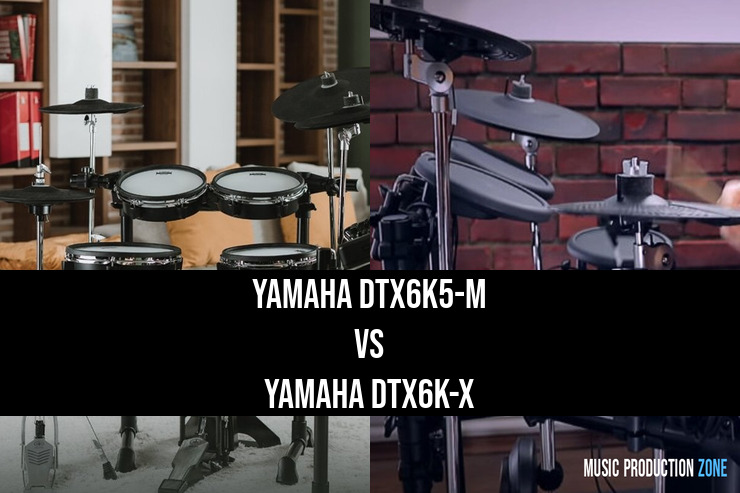
Choose the DTX6K5-M if you want a larger mesh snare, tom rims, a moving hi-hat and two crashes in one matched kit. Keep the DTX6K-X if its pads suit you and your main goal is to improve sounds or recording: the shared DTX-PRO already provides the same underlying options once its firmware is brought up to date. The K5-M upgrade is easiest to justify when several hardware limitations bother you at once.
Yamaha DTX6K5-M vs Yamaha DTX6K-X (2026) Head to Head


The Yamaha DTX6K5-M is the more complete playing setup, with larger mesh drum pads, a stand-mounted hi-hat and a second crash. The DTX6K-X makes more sense if you already own one and are happy with its smaller TCS snare and rubber toms. Both use the DTX-PRO, so moving to the K5-M does not buy a different sound module.
For an existing DTX6K-X owner, the decision is whether to replace several pads and the hi-hat together or improve the parts you use most. The K5-M changes most of the playing surfaces while keeping the familiar Yamaha editing and recording workflow.
Key Differences
The K5-M has a 12-inch XP120L-M mesh snare and three 10-inch XP100L-M mesh toms. The DTX6K-X has an 8-inch XP80 TCS snare and three 7-inch TP70 rubber toms. Mesh tension can be adjusted, and the larger heads leave more room for off-centre strokes. The smaller XP80 uses Yamaha's silicone playing surface; choosing between those surfaces is partly a feel preference, not a simple ranking by diameter.
The K5-M's toms have head and rim zones, while the TP70 toms on the K-X are single-zone. If you assign percussion or alternate tom sounds to rims, that is a useful addition. The snare comparison goes the other way in zone count: the XP80 has separate head, open-rim and closed-rim zones. The dual-zone mesh snare uses the DTX-PRO's cross-stick setting for its rim sounds. A bigger snare does not automatically supply more independently sensed zones.
The K5-M includes a 13-inch RHH135 hi-hat on an HS650A stand. The K-X uses a fixed 10-inch hi-hat pad with an HH65 controller pedal. Both let your left foot control the sound, but the K5-M also gives you the physical movement of a conventional stand and cymbal assembly.
The K5-M supplies two 13-inch PCY135 crashes and a 15-inch PCY155 ride, all three-zone pads. The K-X supplies one 10-inch crash and a 13-inch PCY135 three-zone ride. The extra crash provides another playing position without first buying a pad and mounting hardware; the larger ride also gives you a wider target for bow and bell parts.
The kick tower changes from the K-X's KP65 to the K5-M's larger KP90 with a multilayer cushion. Both accommodate a double pedal. The reason to consider the KP90 is its construction and larger target, rather than assuming the older kit cannot play double-bass parts.
Key Features in Common
Both kits run from the DTX-PRO without a computer. Its Kit Modifier controls give quick access to ambience, compression and effects, with more detailed editing available in the menus. You can keep the Yamaha sound workflow while changing the pads around it.
Both offer a metronome, training functions, audio recording and WAV sample import. USB can carry audio as well as MIDI, so neither kit requires a separate audio interface just to record a stereo mix of the module's sounds. The DTX-PRO has no built-in Bluetooth; backing tracks can come through its wired auxiliary connection.
Both use a rack and a separate kick tower. Mesh or TCS heads do not make either kit silent: stick impacts, pedals and the kick tower still create room noise and vibration through the floor.
Both the Yamaha DTX6K5-M and Yamaha DTX6K-X are equipped with the same drum module (the DTX-PRO), so your choice between the two e-drum kits will be based on your preferences between the pads and hardware on the separate kits.
And here's a video of the Yamaha DTX6K-X.
Check the DTX-PRO firmware before comparing the sound libraries of an older K-X and a newer K5-M. Yamaha's version 2 update expanded the module, and the same update path applies to the existing DTX-PRO. A factory-kit count on an old listing is not evidence that you need a complete new kit to access the newer module features.
USB recording on DTX-PRO is stereo. That works for capturing a finished drum mix, but it does not create separate audio tracks for every drum. Record MIDI if you want to drive a computer drum instrument and change its sounds later. To retain the module's sounds, balance the kit before recording its stereo output.
The K5-M package includes the hi-hat stand, rack and mounting hardware. A kick pedal, throne and monitoring are separate purchases. The K-X's controller pedal handles the hi-hat without an acoustic hi-hat stand, but it still needs a kick pedal. The supplied K5-M snare mounts from the rack; a separate snare stand is not part of this change.
Larger pads and a hi-hat tripod need room for comfortable placement. Leave space for the seat and pedal movement when planning a K5-M setup. If the K-X already fits a tight corner, check where the stand legs and wider toms will sit before treating the change as a direct swap.
For a piecemeal upgrade, check each pad's compatibility, required cable and trigger setting. DTX-PRO input functions vary by socket and pad type; splitting a socket does not preserve every rim or cymbal zone automatically. Price the required pads, holders and hi-hat components together before comparing that route with the complete K5-M.
Price Comparison Between The Yamaha DTX6K5-M and Yamaha DTX6K-X
Use the below to get up-to-date prices for both the Yamaha DTX6K5-M and Yamaha DTX6K-X
Hi-Hat
Cymbal Pads
Toms
Drum Module
Snare
Kick
Overview
Verdict
The DTX6K5-M is the stronger choice when you want to replace the small rubber toms, fixed hi-hat and one-crash layout together. An existing DTX6K-X remains useful if you like its TCS snare and do not need all those hardware changes. Update and explore the DTX-PRO before replacing a complete kit for its sounds alone.
For a cross-brand alternative to the K5-M, see Yamaha DTX6K5-M vs Roland TD316. For the next Yamaha tier against Roland's digital-pad kit, read Yamaha DTX8K-M vs Roland TD516.

Matt Taylor